
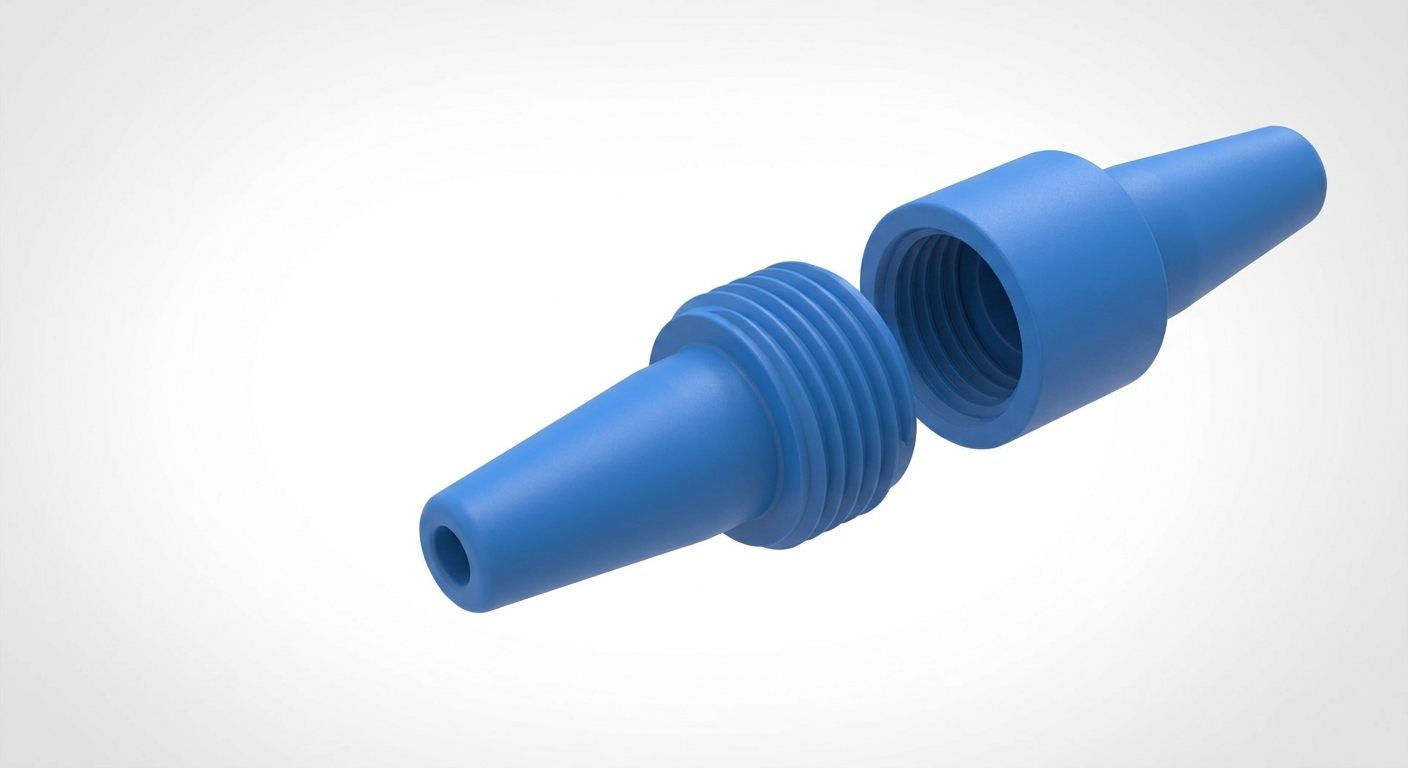
Understanding the “Luer Connection” (and why connector safety is changing)
If you’ve ever seen medical tubing connected during IV therapy, imaging, or a hospital procedure, you’ve likely encountered a Luer connection—even if no one called it that. It’s one of the most common ways healthcare teams join fluid pathways reliably, quickly, and (when used correctly) with good leak resistance. But because this “universal” fit became so widespread, healthcare standards are evolving to reduce the risk of tubing misconnection errors—situations where two things can physically connect even though they should never be connected clinically.
What is a Luer connection (in plain language)?
A Luer connection is a standardized medical connector used to join components that need leak-resistant fluid transfer—for example, between medication delivery components, IV-related components, and other clinical tubing systems. The main reason it’s so common is simple: it became an international standard, which meant parts from different manufacturers could fit together consistently. That interchangeability helped healthcare systems scale and simplify supplies in fast-moving environments where teams need familiar, predictable connections.
Patients commonly encounter Luer-style connections during:
- IV therapy and medication delivery
- Injections and contrast delivery for certain imaging workflows
- Hospital or clinic tubing connections where fluids must move safely from one component to another
A helpful way to think about it: a Luer is like a standardized “universal shape” for small-bore medical fluid connections. That universality is convenient—until it creates the possibility that unrelated lines can be joined by mistake.
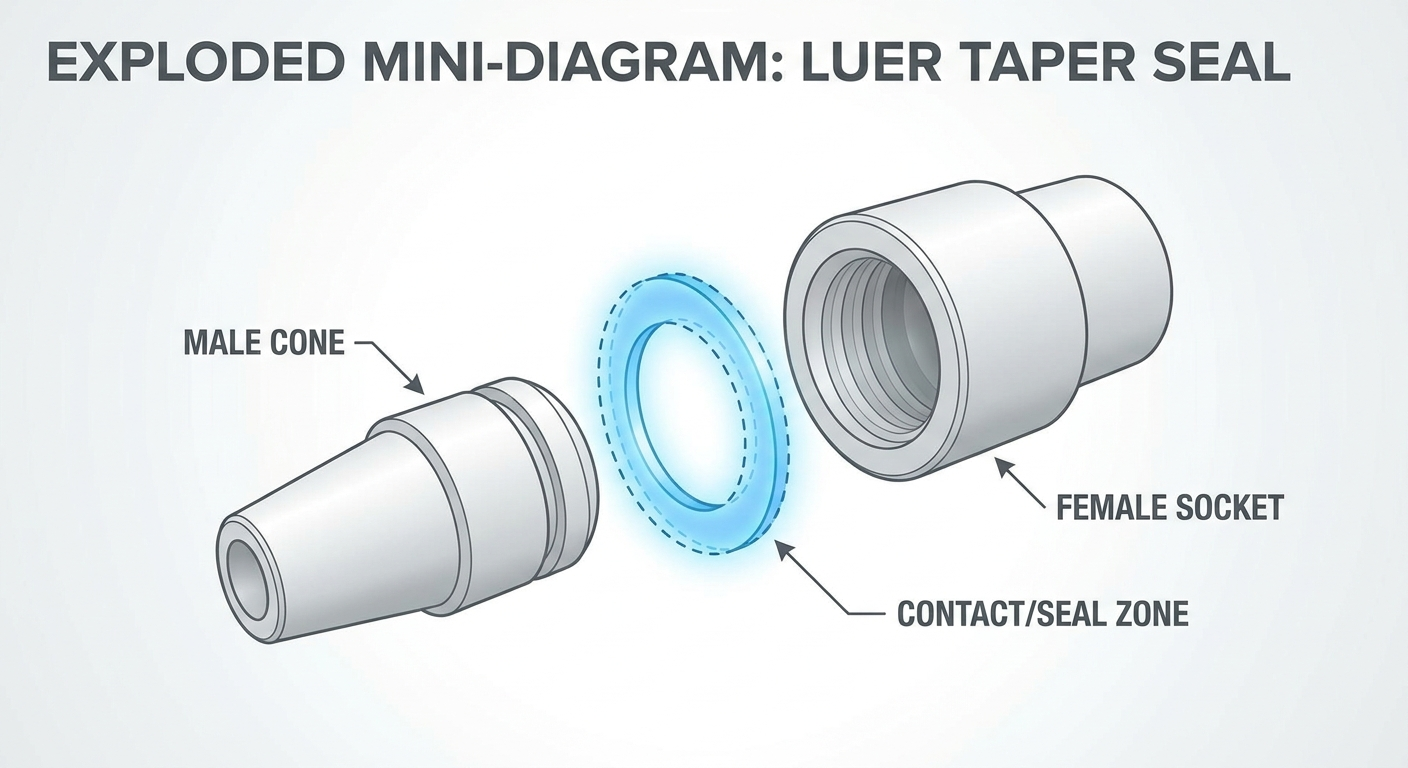
The Luer taper—how the seal is created
- A male taper (slightly cone-shaped) fits into a female connector
- As they are pressed together, the taper creates a tight seal that helps resist leaks
- Today, Luer connector performance is addressed within the ISO 80369 family, especially ISO 80369-7 for intravascular and hypodermic applications, which superseded older ISO 594 requirements
In short: Luer connectors are common because they are standardized and predictable—but “universal fit” also introduces the risk of connecting the wrong things together.
Luer Slip vs. Luer Lock—what’s the difference?
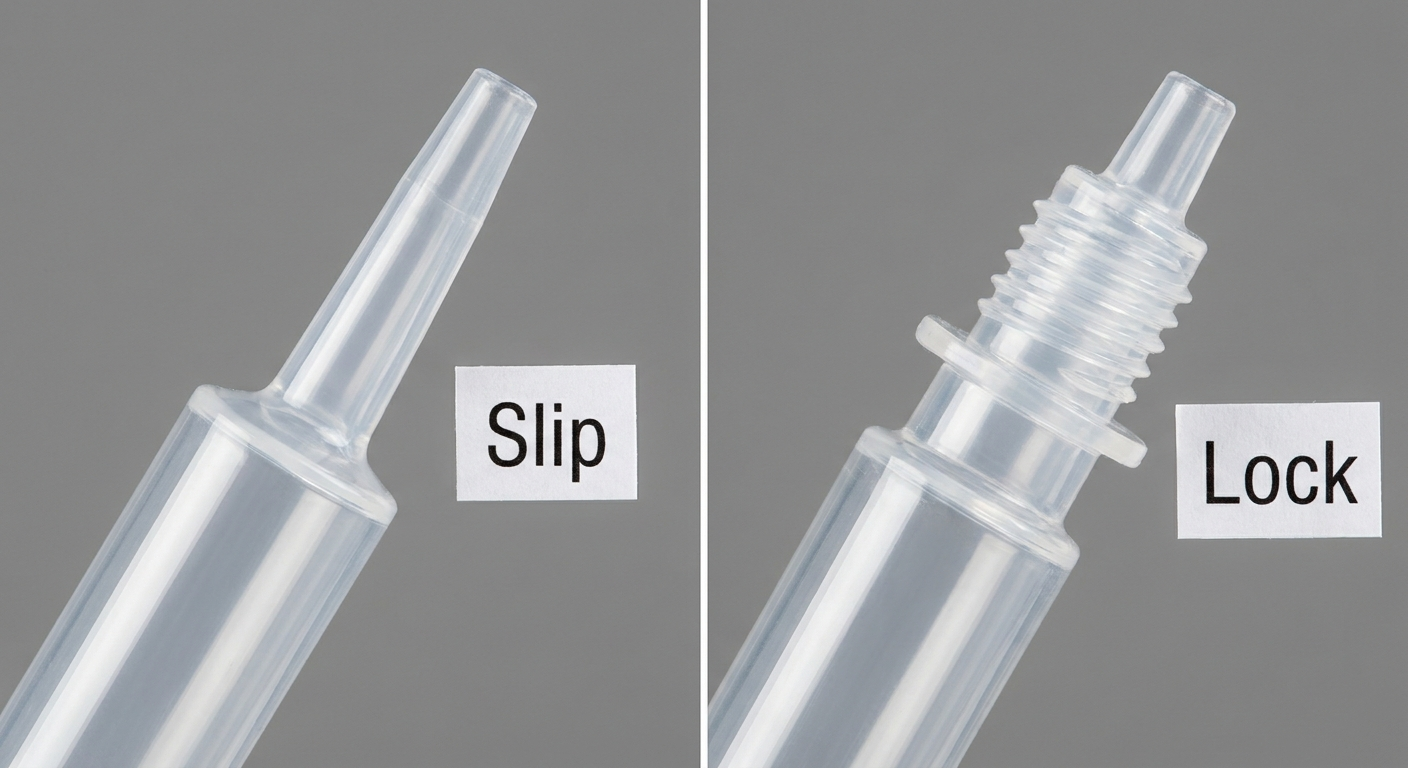
Both types seal using the Luer taper, but they differ in how they stay connected—and that matters in real-world clinical use.
Luer Slip (friction-fit)
- Connection: push-to-fit (sometimes with a small twist)
- Benefits: quick, simple, widely available
- Tradeoffs: more likely to loosen with pulling/tugging, motion, or higher pressure
Luer Lock (threaded collar)
- Connection: twist-to-lock via a threaded mechanism
- Benefits: more resistant to accidental separation, preferred where motion/tension or higher pressure may occur
- Tradeoffs: slightly slower to connect
A Luer Lock can improve mechanical security against accidental disconnection, but it does not, by itself, prevent wrong-route misconnections. Physical incompatibility between different clinical applications is addressed by the ISO 80369 family of standards.
Bottom line: choose connection styles for the workflow and risks—speed for simple, low-tension tasks; thread-locked security when motion or pressure could challenge the connection.
Why medical standards are moving beyond “universal” Luer connectors
Because the Luer taper became so universal, many unrelated clinical systems historically shared compatible connections. That convenience has a downside: tubing misconnection can happen when different lines physically fit together but should never be connected clinically.
This safety-driven shift is why the industry is adopting application-specific connectors. The goal is moving from “many things can connect to many things” to “only the right things can connect.”
What is a “misconnection,” and why can it be dangerous?
- A misconnection occurs when tubing or delivery components are accidentally connected to the wrong access point or route.
- These events are uncommon but can be severe. Connector design is one layer of prevention among others like training, labeling, protocols, and line tracing.
- A practical takeaway: if a connection seems like it “almost fits,” pause and ask rather than forcing it.
ISO 80369—application-specific connectors designed to prevent mix-ups
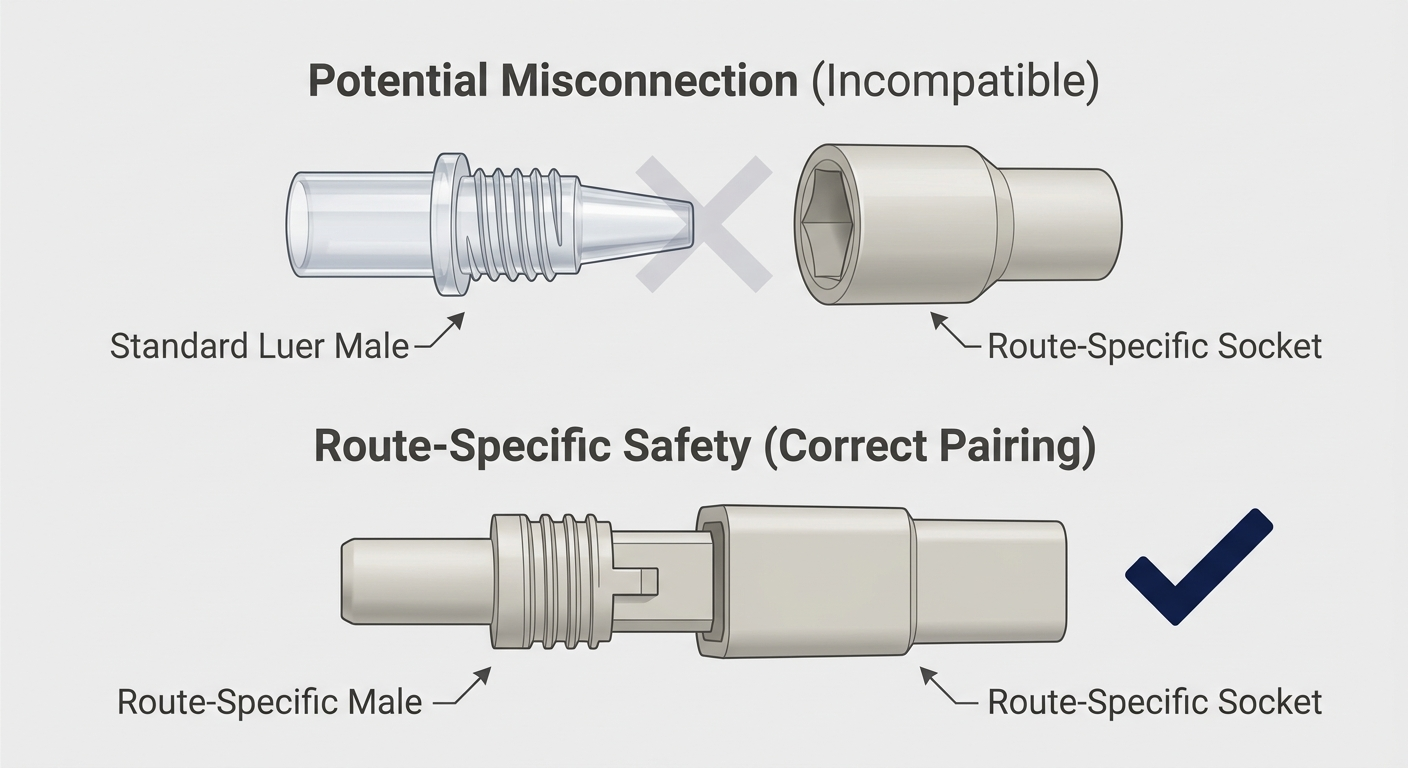
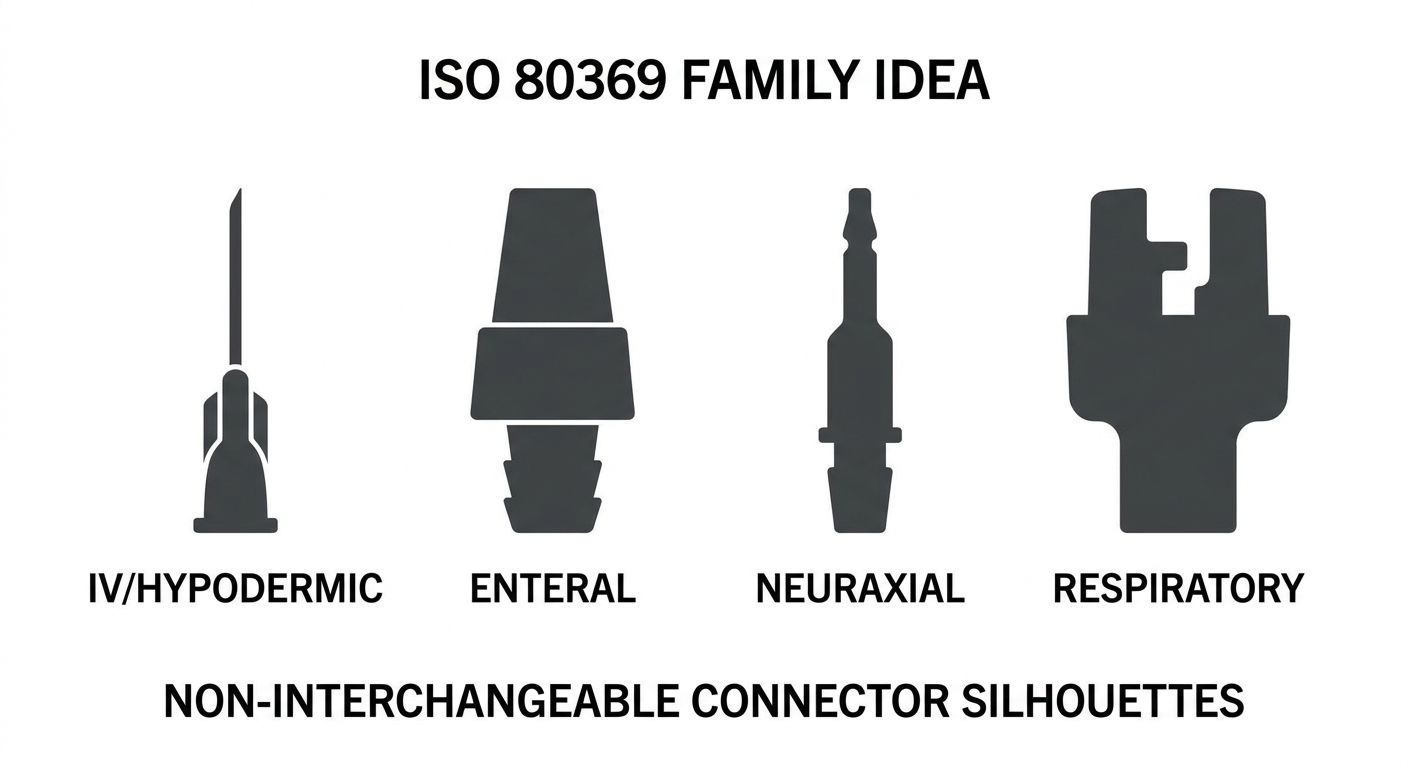
- ISO 80369 is a family of standards for small-bore connectors designed to reduce the risk of misconnections between different clinical applications (for example, intravascular/hypodermic, enteral, neuraxial, respiratory)
- The intent is to make connectors for different routes physically incompatible with each other
The direction of travel is clear: more route-specific connectors to make the wrong connection harder to make in the first place.
Spotlight example: the NRFit connector (and why it won’t fit a standard Luer)
One connector you may hear about—especially for spinal/epidural workflows—is NRFit. NRFit is part of the broader move away from “one connector fits all.”
What makes NRFit different from a standard Luer?
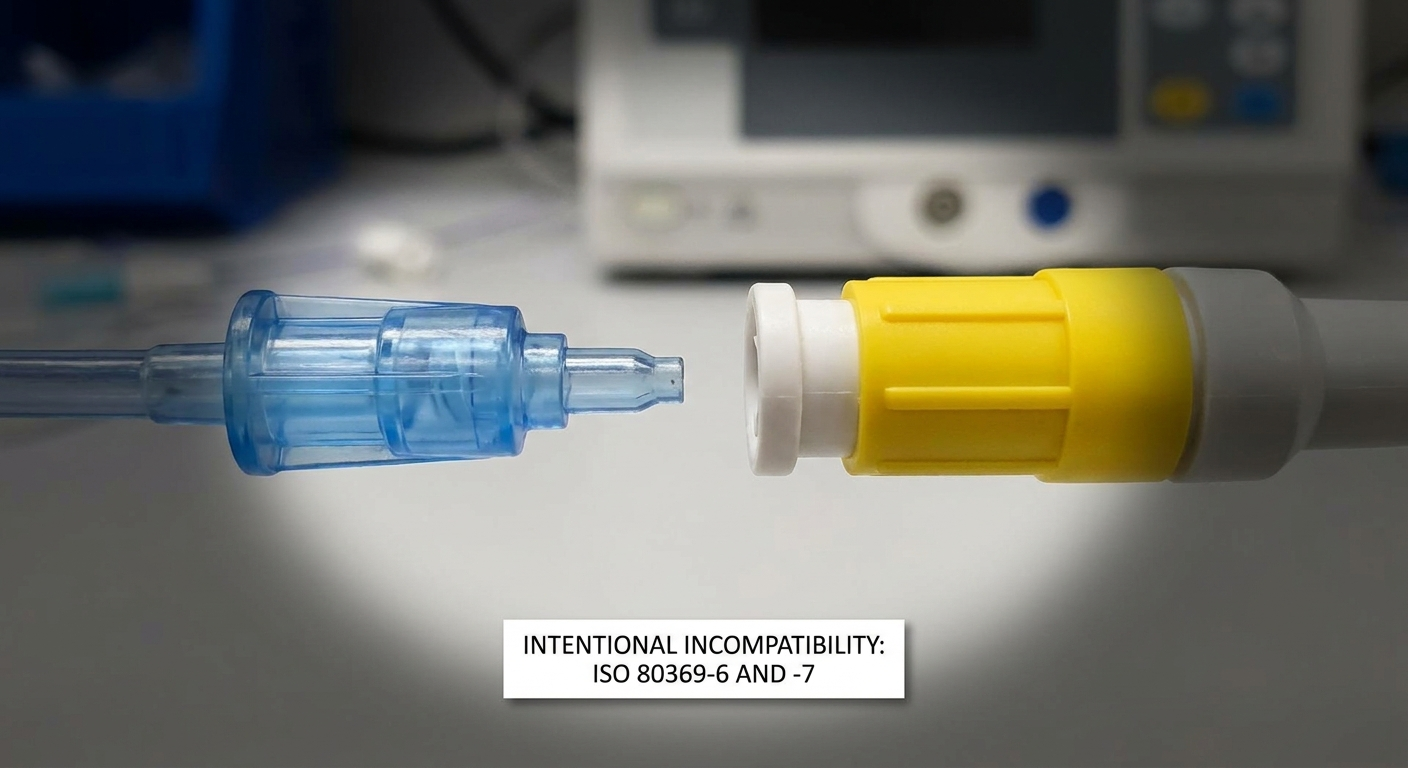
- NRFit (defined in ISO 80369-6 for neuraxial applications) is intentionally incompatible with the traditional Luer taper used in many intravascular/hypodermic systems (ISO 80369-7)
- It uses different geometry so it cannot mate with standard Luer connectors
That “won’t fit” feature isn’t a bug—it is the safety feature.
What the NRFit rollout may look like in hospitals and clinics
- During transitions, facilities may have periods where both older and newer connector types are present
- Rollouts typically involve staff training, updated procedures, supply management and labeling, and planned replacement of compatible parts
- A helpful safety rule in any setting: if it doesn’t fit easily, don’t force it—pause and ask for guidance
In practice: NRFit’s incompatibility is by design, helping to prevent wrong-route neuraxial connections before they happen.
What patients and caregivers should know (and ask) about connectors
Quick questions to ask your care team:
- What route is this medication intended for?
- Is this connector a standard Luer connection or a route-specific connector (such as NRFit)?
- Should any adapters be used—or avoided?
If you’re told an adapter is needed, it’s reasonable to ask why—because adapters can sometimes reintroduce compatibility between systems that are intentionally designed not to connect.
At-home or discharge supplies: how to reduce confusion
- Use only the provided/approved tubing and connectors from your care team
- Avoid mixing parts from different kits, even if they “look like they should fit”
- Keep packaging and instructions so you can match components correctly
- If something doesn’t connect easily, stop and contact your clinician or pharmacist rather than forcing it
- For device-specific use and safety information, refer to the ClearPath Instructions for Use: https://www.clearpathnasal.com/instructions-for-use
When in doubt, pause and ask—don’t force a connection.
Where Luer connections show up in minimally invasive ENT tools (ClearPath-relevant context)
Standardized connectors matter in many areas of care—including minimally invasive ENT procedures—because consistent connections can support reliable setup, predictable performance, and leak resistance when fluids or pressure are being controlled.
ClearPath is a device used in ENT care; you can learn more about the ClearPath Nasal Balloon Catheter (CNB) and how the system is designed for procedural use: https://www.clearpathnasal.com/product/clearpath-nasal-balloon-catheter-cnb
Why secure, leak-resistant connections matter in balloon-based tools
- Balloon-based tools rely on controlled pressure and stable delivery pathways
- In many systems, threaded, more secure connection styles (often associated with Luer Lock–type mechanics) are used where disconnection or leakage could interfere with control
- You can think of it like tightening a garden-hose coupling: the goal isn’t just to connect two parts, but to keep the connection stable while pressure is applied
To see where connection integrity fits into broader safety considerations, see why safety matters in septoplasty: https://www.clearpathnasal.com/blog/why-safety-matters-how-clearpath-reduces-risks-in-septoplasty
For a procedural walk-through that shows where connections and pressure control come into play, see how the ClearPath nasal balloon works (step-by-step): https://www.clearpathnasal.com/blog/how-the-clearpath-nasal-balloon-works-a-step-by-step-guide
Stable, leak-resistant connections support smoother workflows and help maintain control during pressure-based steps.
Clinical outcomes snapshot (context and limitations)
In one retrospective analysis of 107 consecutive CNB-assisted septoplasty cases, the authors reported:
- No major intra- or postoperative complications in the cohort (including no septal perforation, hematoma, mucosal injury, infection, synechia, or conversion to traditional septoplasty)
- CT symmetry improvements of 22% at the NLD and 45% at the PMD
- SNOT-22 improvement from 58.7 to 44.8 at one month (a 23.8% reduction)
These findings reflect one retrospective study and may not generalize to all patients, techniques, or care settings. Individual results can vary. Clinical decisions should be based on clinician judgment, patient needs, and device labeling.
FAQs about the Luer connection
Are all syringes and needles Luer?
No. Many are, but not all. Some applications use non-Luer, route-specific connectors (for example, neuraxial or enteral connectors) to reduce the chance of tubing misconnection. If you’re unsure, check labeling and confirm with a clinician or pharmacist.
Is a Luer Lock always safer than a Luer Slip?
A Luer Lock is often more secure against accidental separation, but “safer” depends on context. It does not automatically prevent wrong-route connections; route-specific connector standards (like ISO 80369) target that risk.
Can hospitals still use standard Luer connectors?
Yes. Standard Luer systems remain widely used for appropriate applications. Many facilities also adopt route-specific connectors where misconnection risk is a key concern.
What should I do if an NRFit connector doesn’t fit my equipment?
Don’t force it. Stop and ask your care team for the correct component or approved setup. NRFit is designed not to fit a standard Luer taper on purpose.
Why not just use adapters for everything?
Adapters can reintroduce compatibility between systems that are meant to be incompatible—potentially undermining the safety benefit. If an adapter is ever used, it should be specifically approved and provided by the healthcare team for that situation.
Key takeaways
- A Luer connection is a widely used, standardized tapered fitting designed for leak-resistant connections
- Luer Slip is fast and simple; Luer Lock adds a threaded mechanism for a more secure attachment
- Safety standards are moving toward route-specific connectors (ISO 80369 family) to reduce the risk of tubing misconnection
- NRFit (ISO 80369-6) is an example of this shift: it is intentionally incompatible with standard Luer connectors (ISO 80369-7) to help prevent wrong-route events
- In ENT care, consistent, secure connections can support controlled setup and predictable performance in minimally invasive tools
For questions about whether any device or procedure is appropriate for your situation, consult a qualified ENT specialist.
Medical disclaimer
This article is for general educational information only and is not medical advice. Always follow your clinician’s instructions and your device’s labeling, and ask a qualified healthcare professional if you have questions about connectors, tubing, or procedure options.
Sources
- ISO 80369-7: Small-bore connectors for liquids and gases in healthcare applications—Part 7: Connectors for intravascular or hypodermic applications (supersedes ISO 594)
- ISO 80369-6: Small-bore connectors for liquids and gases in healthcare applications—Part 6: Connectors for neuraxial applications
- ISO 80369 family overview: https://www.iso.org/obp/ui/en/#iso:std:iso:80369:-1:ed-2:v1:en
- U.S. FDA. Small-bore connectors for liquids and gases in healthcare applications—Guidance for Industry and FDA Staff (safety background on misconnections)
- The Joint Commission. Sentinel Event Alert: Tubing misconnections—A persistent and potentially deadly occurrence (risk overview and prevention strategies)
- StayConnected.org. NRFit FAQs: https://stayconnected.org/nrfit-faqs/
- HSE National Patient Safety Alert (2025). Implementation of NRFit: https://www2.healthservice.hse.ie/documents/7711/HSE_NPSA_001-2025_Implementation_of_NRFit_F2LbeXJ.pdf
- Dillard J, Koudouovoh C, Lee V, et al. (2026). Outcomes of force-directed balloon-assisted endoscopic septoplasty… Rhinology Online. doi:10.4193/RHINOL/25.018
This article is for educational purposes only and is not medical advice. Please consult a qualified healthcare provider for diagnosis and treatment.

Dr. David G. Dillard
Author
Share it with others!


