

How ClearPath Addresses the “Point of Maximal Deviation” (PMD)
If you’ve been told you have a deviated septum, you may also hear your clinician describe the point of maximal deviation—the spot where the septum appears most “off-center” and airflow may be most restricted. This matters because even a small pinch point can disproportionately affect breathing, sleep, and day-to-day comfort.
ClearPath is a device intended to help clinicians address that tightest segment using a controlled, potentially less disruptive approach called balloon-assisted endoscopic septoplasty. Below, we’ll explain what the point of maximal deviation is, how it may be identified, and what one published study reported when clinicians used the ClearPath Nasal Balloon to target it.
What Is the “Point of Maximal Deviation” (PMD)?
A simple definition (the narrowest spot in a deviated septum)
Think of your nasal septum as the “divider” between the left and right sides of your nose. When it’s deviated, it bends or shifts—sometimes creating the narrowest point of a deviated septum where airflow has the hardest time getting through. Many clinicians refer to this narrowest spot as the point of maximal deviation (PMD), though the term isn’t universal.
A practical analogy
If you’ve ever tried to sip through a straw that’s bent in one place, the bend—not the rest of the straw—often determines how hard you have to work. PMD is like that “bend” in the septum where airflow may face the most resistance.
If you’ve ever wondered “Where is my deviated septum worst?” PMD is a practical way of describing that “tightest pinch point.”
To learn more about the concept itself, see this overview: point of maximal deviation (PMD) (https://www.clearpathnasal.com/blog/the-point-of-maximal-deviation-what-it-means-for-your-airflow)

Why PMD matters for breathing and symptoms
Your nose works best when air can flow smoothly through both sides. When the narrowest point of a deviated septum becomes too tight, you may notice symptoms such as:
- One-sided nasal blockage (sometimes switching sides)
- A stuffy or “always congested” feeling
- Mouth breathing and dry mouth at night
- Poor sleep quality or snoring-related disruption
- Facial pressure or headache sensations (for some people)
Not every symptom is caused by the septum alone, but PMD can be a meaningful contributor when the main issue is structural narrowing. For example, someone might notice they can breathe better through one side only when they pull their cheek to the side—an informal clue that structure (not just inflammation) may be playing a role.
PMD as a reference point doctors can track
PMD can also serve as a consistent “checkpoint.” Clinicians may evaluate it during an exam and, when appropriate, track changes over time with imaging. In other words, it’s a repeatable way to ask: “Did the narrowest segment actually open up?”
A clinician-friendly way to summarize PMD is: if the tightest spot can be improved, there may be a meaningful opportunity for airflow improvement—assuming other contributors are addressed, too.
*Bottom line: PMD is a practical, descriptive target for understanding and discussing where the septum is most limiting airflow.*
How Clinicians Identify the PMD (and Confirm What’s Contributing to Your Blockage)
Nasal endoscopy: looking directly at the tightest area
A nasal endoscopy is an in-office exam where a clinician uses a small scope to look inside the nose with good lighting and magnification. For patients, this typically means:
- A focused look at where airflow seems most limited
- A clearer view of the septum shape and nearby tissues
- A chance to spot other contributors to blockage (like tissue swelling or other anatomic factors)
This direct view can help confirm where the “pinch point” is and whether it matches your symptoms. It also supports a more specific discussion than “your septum is deviated,” such as: “The tightest narrowing is here, and it corresponds to the side you feel blocked most.”

CT imaging: mapping anatomy and measuring narrowing
Sometimes a CT scan is helpful—especially when the goal is careful anatomical mapping or objective measurement. CT imaging can show:
- How far the septum deviates at key landmarks
- Where narrowing appears most pronounced (including the PMD)
- How alignment changes after treatment in measurable terms (when pre- and post-treatment CTs are available)
For more on imaging, see how we use CT scans to diagnose nasal blockages (https://www.clearpathnasal.com/blog/how-we-use-ct-scans-to-diagnose-nasal-blockages).
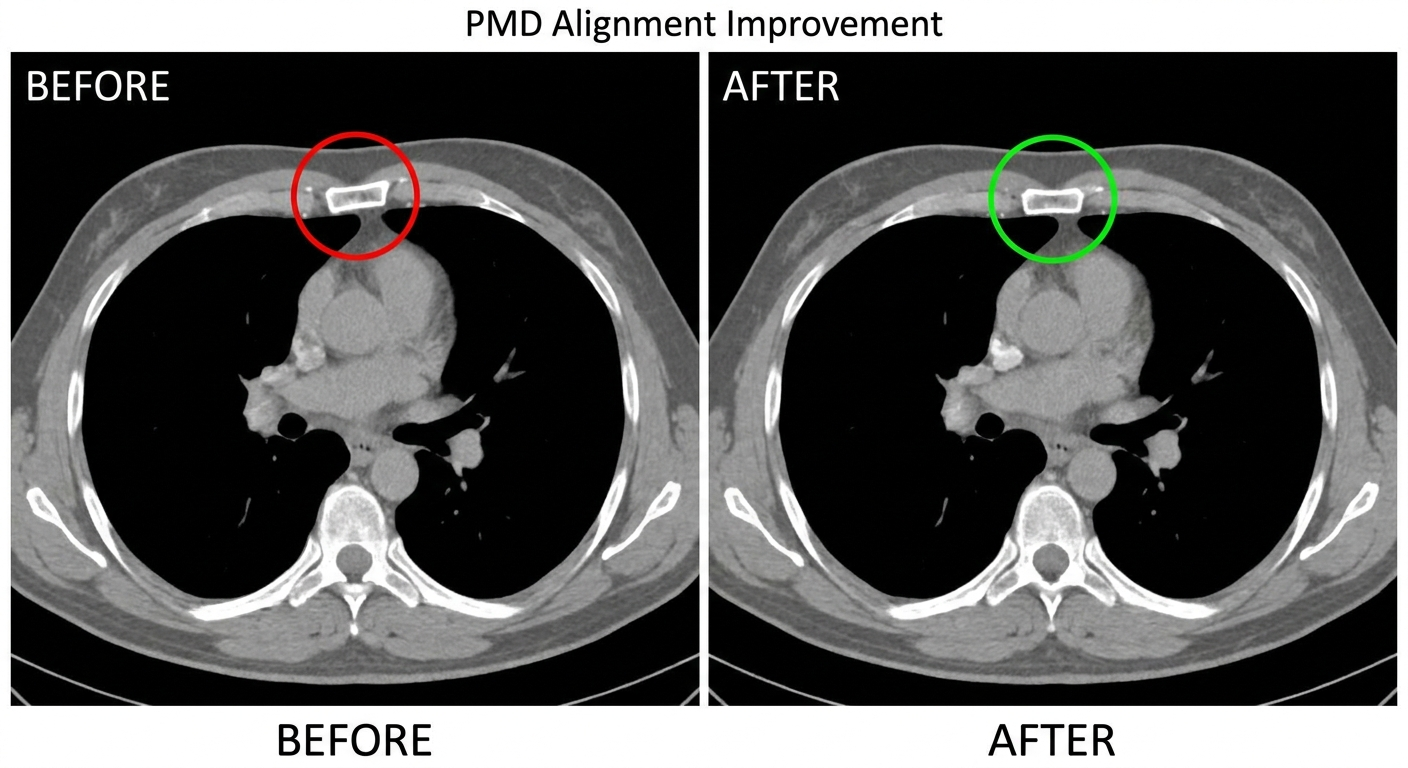
In one retrospective analysis of balloon-assisted endoscopic septoplasty, CT-based measurements were used to quantify septal alignment change at the PMD and other landmarks—an anatomy-based datapoint alongside how a patient feels (Dillard et al., 2026).
*In short: endoscopy helps clinicians see the tightest point directly, and CT—when used—can help measure change objectively over time.*
The ClearPath Approach: Repositioning the Septum at the PMD with Controlled Pressure
What “balloon-assisted endoscopic septoplasty” means
Balloon-assisted endoscopic septoplasty combines:
- Endoscopic visualization (the clinician can see the anatomy clearly)
- Balloon technology (controlled, targeted pressure applied to the deviated segment)
The intent is to address the obstructing deviation while aiming to reduce unnecessary disruption to surrounding tissue compared with more extensive approaches, when clinically appropriate.
The role of the ClearPath Nasal Balloon (CNB)
The ClearPath Nasal Balloon is designed to apply controlled pressure to the deviated cartilage and/or bone at the obstruction site. In patient-friendly terms, clinicians use the ClearPath device to help guide and reposition the septum—rather than relying primarily on extensive cutting or tissue removal. More precisely, the device is intended to help guide repositioning at the key obstruction point.
That’s why many describe this as a minimally invasive option for selected patients—not because it replaces evaluation or expertise, but because the device-enabled approach focuses on controlled correction at the most relevant point. Depending on anatomy and surgeon preference, the approach may also potentially reduce steps associated with more extensive surgery (such as wide flap elevation, suturing, or packing), when clinically appropriate.
Learn more in this step-by-step overview: how the ClearPath Nasal Balloon works (https://www.clearpathnasal.com/blog/how-the-clearpath-nasal-balloon-works-a-step-by-step-guide).

Why PMD is a key target during the procedure
If the point of maximal deviation is the narrowest place, it’s often where correction may make the biggest difference in airflow. Targeting that specific segment is a practical strategy: improving the tightest area may help improve nasal airflow where it matters most, while still considering the rest of the nasal anatomy.
A simple way some clinicians explain the strategy is: “Open the bottleneck first.” It doesn’t mean other anatomy is ignored—it means the procedure is often planned around the spot most likely to be limiting airflow.
*Big picture: ClearPath aims to enable focused, controlled correction at the tightest point, under direct visualization, in appropriately selected patients.*
What the Research Shows: Alignment and Symptom Changes Reported After CNB-Assisted Septoplasty
One retrospective study provides both objective measurements (CT) and patient-reported symptom scores (SNOT-22). Results vary by individual, and findings from one study may not apply to everyone, but they offer helpful context.
Objective CT results at the PMD
In a retrospective analysis (Dillard et al., 2026), a subset of patients had both pre- and post-procedure CT scans. Among 23 patients with CT pairs, there was an average ~45% improvement in septal alignment at the point of maximal deviation, which was statistically significant (p = 0.005). This suggests measurable opening and straighter septal alignment on CT at the most restricted point in this cohort.
Improvements at other anatomic landmarks (e.g., NLD)
The same study also measured alignment at the nasolacrimal duct (NLD) region, reporting ~22% mean symmetry improvement there as well.
Patient-reported outcome change (SNOT-22)
SNOT-22 is a validated questionnaire that asks about common nose and sinus-related symptoms and quality-of-life impacts (including sleep and daily functioning). For background, see this explainer on the SNOT-22 score (https://www.clearpathnasal.com/blog/the-snot-22-score-measuring-your-sinus-health). In the study, 43 patients completed SNOT-22 surveys, and average scores improved from 58.7 to 44.8 at 1 month—a 23.8% reduction. The authors noted the biggest early gains in nasal congestion, headache/facial pressure, and sleep quality. These are cohort averages at an early time point and do not predict an individual outcome.
Who may see the greatest proportional correction
Not every deviated septum is the same. In this dataset, patients with more severe deviation (>10 mm) showed the greatest proportional improvement. Overall, 78% (18/23) achieved ≥30% alignment improvement on CT in the paired-scan subgroup.
Study size and why it matters
The analysis reported 107 consecutive cases using the technique and ClearPath device approach, with 23 CT pairs for objective measurement and 43 SNOT-22 completions. Larger and comparative studies would be valuable to confirm and extend these findings across broader groups. This study did not establish superiority over traditional septoplasty.
Safety observations in the cohort
In this study cohort, the authors reported no major intraoperative or postoperative complications, including no perforation, hematoma, mucosal injury, infection, synechia, or conversion to traditional septoplasty.
*Takeaway: A retrospective study reported measurable CT alignment changes at the PMD and early symptom improvements on average, but individual results vary and more research is warranted.*
How ClearPath May Differ from Traditional Septoplasty (In Patient Terms)
Potential design goals
ClearPath’s balloon-assisted endoscopic approach is intended to:
- Address the most obstructive segment (often the point of maximal deviation) directly
- Use controlled pressure to assist with repositioning
- Potentially reduce disruption to surrounding tissue compared with more extensive approaches (when clinically appropriate)
Because every nose is different, the right technique depends on anatomy, goals, and clinician judgment. Some patients may need traditional structural correction; others may be candidates for a more targeted, device-assisted approach focused on the key obstruction point.
For a broader comparison, see ClearPath vs traditional septoplasty (https://www.clearpathnasal.com/blog/clearpath-vs-traditional-septoplasty-recovery-safety-results).
*In essence: technique selection is individualized—ClearPath may be one minimally invasive option for selected patients, based on clinician assessment.*
What Patients Can Expect: From Evaluation to Recovery (High-Level Overview)
Pre-visit and evaluation
A typical pathway may include:
- Reviewing symptoms and history (daytime breathing, sleep disruption, congestion patterns)
- A nasal exam and often endoscopy to identify where obstruction seems greatest
- Possible CT imaging if your clinician needs detailed mapping or objective measurement
If it helps to prepare, consider jotting down a few specifics before your visit: which side feels blocked most often, whether symptoms change with exercise or seasons, and whether you wake up with a dry mouth (a clue that mouth breathing may be happening at night).

Procedure day basics (high-level)
While details vary, balloon-assisted endoscopic septoplasty generally involves:
- Visualization of the deviated area with an endoscope
- Positioning the ClearPath device to target the key obstructing segment
- Applying controlled pressure to help reposition the deviated area—often focusing on the narrowest point of a deviated septum
Many patients find it reassuring that the “target” is not vague—the goal is typically tied to a specific anatomic bottleneck identified during evaluation.
Early recovery and follow-up
Early healing commonly involves:
- Temporary swelling and fluctuating airflow as tissues settle
- Follow-up visits to monitor healing and breathing progress
- Clear guidance on when to contact your clinician (increasing pain, fever, significant bleeding, or new/worsening symptoms)
This article is educational and not a substitute for personalized medical advice.
*Practically speaking: evaluation clarifies whether a device-assisted, targeted approach is appropriate for your anatomy and goals, and follow-up helps track healing and outcomes.*
FAQs About PMD and ClearPath
Does fixing the PMD always fix my breathing?
Not always. The point of maximal deviation can be a major driver of blockage, but breathing can also be affected by other structures and by inflammation. A comprehensive evaluation helps identify all contributors.
A helpful way to think about it: PMD may be the biggest structural bottleneck, but swelling (from allergies or irritants) can still narrow the airway even after alignment improves.
Can a deviated septum come back after treatment?
Healing varies from person to person. Structural tissues can remodel as they heal, and long-term outcomes depend on anatomy, severity, and overall nasal health. Your clinician can explain what is most likely in your specific case.
How do I know if my blockage is “structural” vs allergies?
Many people have both. Structural blockage often feels consistently one-sided or persistent, while allergies often fluctuate with triggers and seasons—though overlap is common. An exam (and sometimes imaging) can clarify the main drivers.
*Key reminder: an individualized assessment is the best way to understand what’s causing your symptoms and which options fit your needs.*
Next Steps: Talk to an ENT Specialist About Your PMD and Options
Questions to ask at your consultation
Consider asking:
- “Where is my point of maximal deviation?”
- “Is the obstruction mainly cartilage, bone, or both?”
- “Do I need a CT scan to measure septal alignment or plan treatment?”
- “What else might be contributing to my nasal blockage?”
- “Am I a candidate for balloon-assisted endoscopic septoplasty using the ClearPath device?”
If you’re exploring options to improve nasal airflow, start by reviewing our PMD explainer and the step-by-step overview of how the ClearPath Nasal Balloon works (links above). Then ask your local ENT specialist (otolaryngologist) whether ClearPath may be an appropriate, potentially less disruptive option compared with more extensive septoplasty approaches for your specific anatomy and symptoms.
*Next step: a conversation with an otolaryngologist (ENT) can help determine whether a targeted, device-assisted approach is reasonable for you.*
References
- ClearPath Nasal Blog (2025/2026). “The Point of Maximal Deviation: What It Means for Your Airflow.” https://www.clearpathnasal.com/blog/the-point-of-maximal-deviation-what-it-means-for-your-airflow
- Dillard J, Koudouovoh C, Lee V, et al. Outcomes of force-directed balloon-assisted endoscopic septoplasty: a retrospective analysis with a new technique and device. Rhinology Online. 2026;9:18–23. doi:10.4193/RHINOL/25.018
This article is for educational purposes only and is not medical advice. Please consult a qualified healthcare provider for diagnosis and treatment.

Dr. David G. Dillard
Author
Share it with others!


