

How ClearPath Targets the Inferior Turbinate
Feeling like you can’t get a full breath through your nose isn’t always “just allergies.” For many people, the bottleneck is structural—often involving the inferior turbinate and, frequently, a deviated septum and turbinate swelling happening together.
This article explains what the inferior turbinate does, why it can contribute to blockage, and how ClearPath is described as targeting the inferior turbinate using a space-making approach intended to minimize tissue disruption. You’ll also see what published outcomes and safety findings have reported so far, in plain language.
Why the Inferior Turbinate Matters for Nasal Breathing
What is the inferior turbinate?
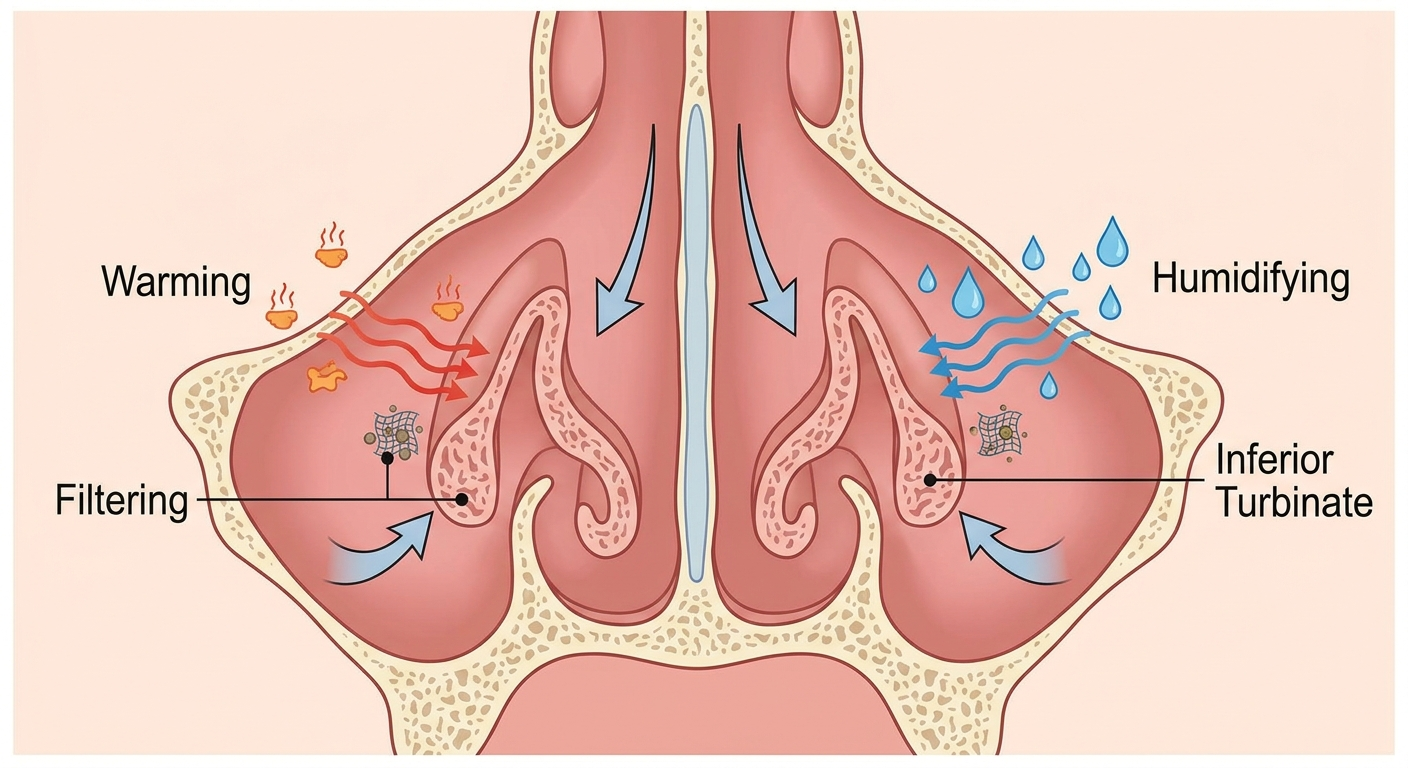
The inferior turbinate is a long, curved structure along the sidewall of your nose. It’s covered in soft tissue and helps warm, humidify, and filter the air you breathe.
A useful analogy: think of the turbinate like a built-in “air conditioning and filtration” unit. It’s supposed to take up some room because it’s doing important work. But because it sits inside the airway, its size and position matter.
If it becomes enlarged (often called inferior turbinate hypertrophy) or sits too far inward, it can narrow the breathing channel and make airflow feel restricted—like trying to breathe through a straw rather than an open tube.
For a deeper anatomy overview, see the role of the turbinates in nasal obstruction: https://www.clearpathnasal.com/blog/the-role-of-turbinates-in-nasal-obstruction-explained
Common signs the inferior turbinate may be contributing to blockage
Symptoms can vary, but people commonly report:
- One-sided blockage or congestion that alternates sides
- Mouth breathing, especially at night
- Reduced exercise tolerance due to limited nasal airflow
- Poor sleep or waking up feeling “stuffy”
- A “blocked nose” that doesn’t improve much with sprays (when structure—not inflammation—is the main issue)
Clinicians sometimes frame it this way: if symptoms barely budge despite appropriate allergy care, anatomy may be playing a bigger role than swelling alone (though many people have both).
In short: small shifts in turbinate size or position can have big effects on airflow, especially in already narrow passages.
Turbinate Hypertrophy vs. Septal Deviation (And Why They’re Often Connected)
What a deviated septum does to airflow
Your septum is the wall in the center of your nose that separates the left and right nasal passages. If it’s shifted (deviated), it can narrow one side, creating a constant airflow pinch point.
A simple image: imagine a two-lane tunnel where a concrete divider drifts into one lane. Even if the “open” lane looks fine, traffic can still bottleneck—especially when anything else narrows the passage.
How the inferior turbinate can “compensate”
When one nasal passage is narrower, the opposite side may be relatively more open. Over time, the inferior turbinate on that roomier side may enlarge (a “compensatory” response), which can reduce space on the side that initially seemed more open. Add day-to-day swelling on top of that, and breathing can feel limited much of the time.
For more background on this process, see inferior turbinate hypertrophy: https://www.clearpathnasal.com/blog/understanding-turbinate-hypertrophy
ClearPath materials describe the device’s purpose as relieving nasal obstruction by helping to reposition the inferior turbinate and adjacent septal structures. (ClearPath Nasal, FDA-cleared device description, 2019)
Bottom line: septal deviation and turbinate changes often coexist, so a plan that considers both can be helpful.

What ClearPath Is—and What Makes It Different
ClearPath is a minimally invasive nasal balloon system (FDA-cleared)
The ClearPath Nasal Balloon System is a device that received FDA clearance in 2019. It is indicated for patients 17 years and older to facilitate endonasal/transnasal procedures or to relieve chronic nasal obstruction. (ClearPath Nasal, FDA-cleared indication summary)
The overall concept: create more space with minimal tissue disruption
Many people assume improved breathing always requires removing tissue. ClearPath is described as aiming to increase intranasal space by repositioning structures rather than excising them.
In typical use as summarized in published descriptions, the approach may avoid:
- Cartilage excision
- Mucosal flap elevation
- Nasal packing (depending on clinician preference and clinical needs)
This tissue-preserving intent is central to understanding how ClearPath is described as addressing the inferior turbinate without removing it. (ClearPath Nasal; Medical Clinical Case Reports Journal, 2025)
Key idea: the technique focuses on space creation through repositioning, not tissue removal.

How ClearPath Targets the Inferior Turbinate (Step-by-Step, Patient-Friendly)
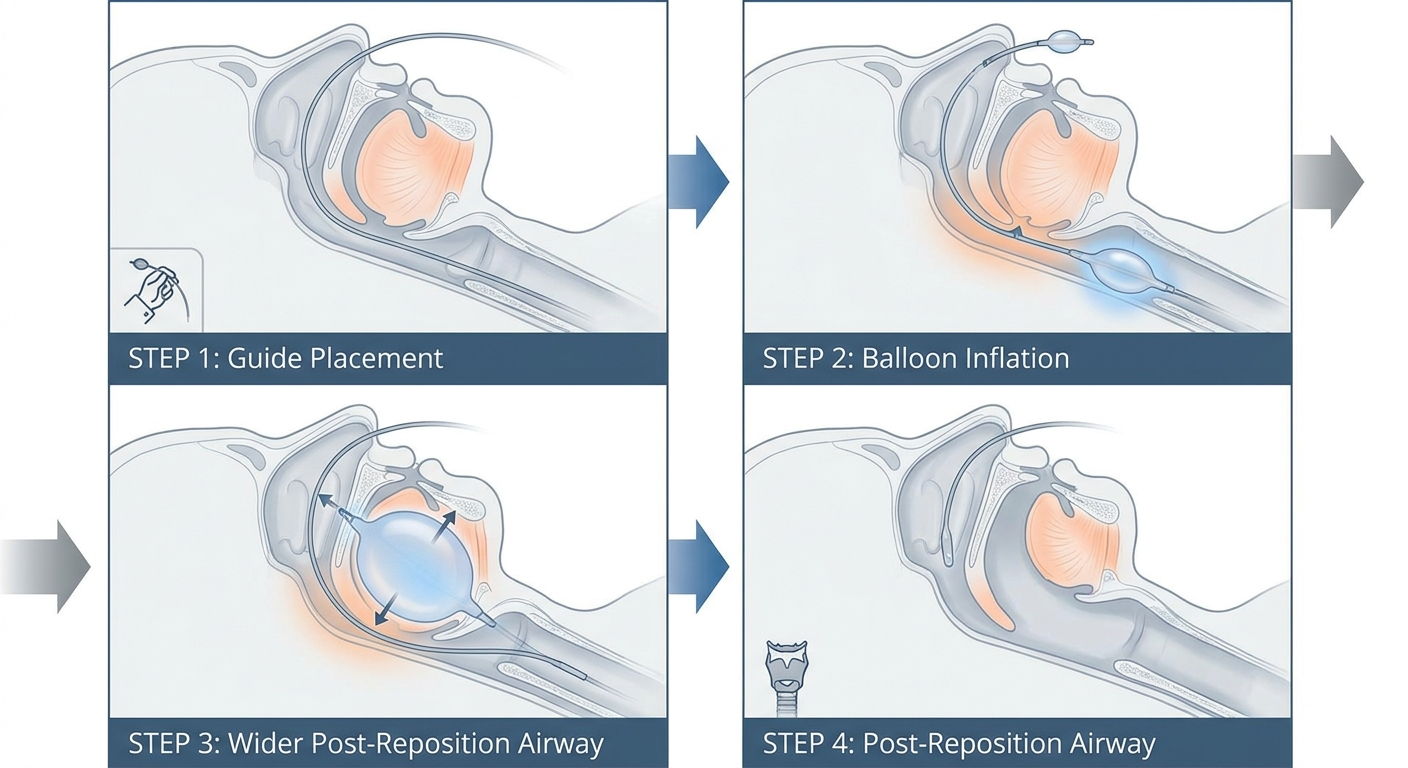
The core mechanism: a fluid-filled balloon delivers controlled, directed pressure to gently displace structures that narrow airflow. Think of a dent carefully pushed out from behind rather than cut away: change the shape or position to restore space, while aiming to preserve tissue.
Step 1 — A curved guide helps aim the treatment
ClearPath includes a curved stainless-steel guide spatula. It functions as a positioning and constraint tool so that dilation is directed where intended rather than spreading pressure broadly. In practical terms, “constraint” here is about precision—creating space where the airflow is pinched, not applying force everywhere. (ClearPath Nasal; Medical Clinical Case Reports Journal, 2025)
Step 2 — A specialized balloon applies controlled pressure
ClearPath uses a fluid-filled balloon that delivers controlled pressure. In patient-friendly terms: rather than cutting tissue, the device is designed to use targeted, controlled pressure to move certain structures slightly and open space. Published descriptions indicate the device is used to help reposition the inferior turbinate and adjacent septal structures to increase nasal space. (ClearPath Nasal; Medical Clinical Case Reports Journal, 2025)
For a deeper dive, see the science of hydrostatic pressure in nasal surgery: https://www.clearpathnasal.com/blog/the-science-of-hydrostatic-pressure-in-nasal-surgery
For a procedure walkthrough, see how the ClearPath Nasal Balloon works (step-by-step): https://www.clearpathnasal.com/blog/how-the-clearpath-nasal-balloon-works-a-step-by-step-guide
Step 3 — The balloon reaches high pressure to precisely reposition tissue
The balloon is described as non-compliant (it does not continue expanding) and as having a design capability of up to 10 atmospheres of pressure. This refers to a device specification, not a sensation a patient directly “feels.” The intent is to deliver pressure in a controlled, targeted way so the clinician can focus the effect where space is needed while aiming to preserve tissue. (ClearPath Nasal; Medical Clinical Case Reports Journal, 2025)
What “displacement” means (and what it doesn’t)
- Displacement means: repositioning the inferior turbinate and adjacent structures to increase airway space.
- It does not mean: removing turbinate tissue (as with a turbinectomy).
Takeaway: the goal is precise, tissue-sparing space creation, not tissue removal.
How ClearPath Compares to Traditional Septoplasty or Turbinate Reduction (High Level)
Traditional approaches may involve cutting, removal, and packing. Traditional septoplasty reshapes or repositions parts of the septum to improve airflow. Traditional turbinate reduction may reduce turbinate size by removing or altering tissue. Some surgical approaches may also involve packing, depending on surgeon preference and specific clinical needs. These approaches can be very effective and remain appropriate for many patients.
ClearPath’s intended approach is to create space with less tissue disruption—no cutting out cartilage, no flap elevation, and, in many cases, no packing as described in device summaries (surgeon preferences may vary). Because the technique is minimally invasive, it may reduce surgical trauma and potentially simplify recovery for certain patients, though outcomes vary by anatomy and severity. (ClearPath Nasal; Medical Clinical Case Reports Journal, 2025)
To explore more, see ClearPath vs. traditional septoplasty: recovery, safety, and results: https://www.clearpathnasal.com/blog/clearpath-vs-traditional-septoplasty-recovery-safety-results
Perspective: think of these options as a spectrum—some people need traditional surgery, while others may be candidates for a balloon-assisted approach.
What Results Have Been Reported? (Symptoms + Imaging Outcomes)
A real-world case series offers combined imaging and symptom data, which can be helpful for understanding both objective and patient-reported changes.
Real-world case series size
A retrospective review included 107 consecutive ClearPath Nasal Balloon (CNB)-assisted septoplasty cases. Within that group:
- 23 patients had pre- and post-procedure CT scans
- 43 patients completed SNOT-22 symptom surveys
(Dillard et al., 2026)
The key takeaway: this is larger than a single case report, with both imaging and symptom data subsets.
CT scans showed improved septal alignment (objective measurement)
Among patients with CT imaging, average septal alignment improved by:
- 22% at the nasolacrimal duct (NLD) level
- 45% at the point of maximal deviation (PMD)
(Dillard et al., 2026)
Patient symptoms improved at 1 month (SNOT-22)
SNOT-22 scores improved from 58.7 to 44.8—a 23.8% reduction at one month. Areas with notable improvement included nasal congestion, headache/facial pressure, and sleep quality. (Dillard et al., 2026)
Patients with more severe deviation showed larger proportional correction
When results were grouped by baseline severity, the severe deviation group (>10 mm) showed the largest proportional correction. In that subgroup, 78% (18/23) achieved at least 30% improvement in alignment. (Dillard et al., 2026)
Summary: in this series, both imaging and symptom measures improved, with proportionally greater alignment gains in the most deviated cases.

Safety Profile: What the Study Reported (In Plain Language)
No major complications were reported in this cohort
In this retrospective cohort, the authors reported no major intraoperative or postoperative complications, including:
- Septal perforation
- Hematoma
- Mucosal injury
- Infection
- Synechiae (scar-band adhesions)
- Conversion to traditional septoplasty
(Dillard et al., 2026)
Important reminder about individual risk
Even with encouraging data, no procedure is risk-free. Anatomy, severity, healing response, and coexisting conditions (like allergic rhinitis or chronic inflammation) can affect outcomes. An ENT evaluation is the best way to match symptoms to the right treatment plan.
Takeaway: published data are encouraging, but individual risks and benefits vary—an ENT can help personalize recommendations.
Who Might Be a Good Candidate (and Who Might Need Other Options)
People with chronic nasal obstruction related to structure
Individuals with a suspected deviated septum plus turbinate swelling—where structure plays a major role—may be evaluated for approaches that address both contributors. Common real-life descriptions include “one side is always worse, especially at night,” or “sprays help a bit, but the blocked feeling returns.”
Age and indication basics
ClearPath is FDA-cleared and indicated for patients 17 years and older. (ClearPath Nasal, indication summary)
When other treatments may be needed
If your blockage is mainly inflammatory (for example, seasonal swelling that responds well to medications) or caused by other nasal conditions, a different plan may be more appropriate. Structural and inflammatory issues can also coexist.
In brief: a focused exam helps determine whether structural, inflammatory, or combined factors are driving symptoms—and which options fit best.
What to Expect After a ClearPath Procedure (Recovery in General Terms)
Why recovery may feel simpler than traditional surgery
Because the approach is intended to create space without cutting or removing tissue—and typically without packing as described in device summaries—some people may find recovery more straightforward than with more extensive surgery. Individual experiences vary based on anatomy and the specific procedure performed.
For a process-focused overview, see a minute-by-minute walkthrough of your ClearPath Nasal Balloon procedure: https://www.clearpathnasal.com/blog/a-minute-by-minute-walkthrough-of-your-clearpath-nasal-balloon-procedure
When to call your clinician
Contact your clinician promptly if you have concerning symptoms such as:
- Bleeding that won’t stop
- Fever
- Severe or worsening pain
- Rapidly increasing swelling
- Any symptom that feels unusual or progressively worse
Simple rule: if something concerns you after the procedure, call your clinician.
Frequently Asked Questions
Does ClearPath remove turbinate tissue?
No. Published descriptions indicate the device is designed to help reposition (displace) tissue to increase space rather than remove turbinate tissue. (ClearPath Nasal; Medical Clinical Case Reports Journal, 2025)
Is the pressure safe?
ClearPath uses a fluid-filled balloon to deliver controlled, targeted pressure. The “up to 10 atmospheres” detail is a design capability of the non-compliant balloon, not a direct reflection of what a patient perceives. Safety depends on appropriate evaluation and technique; in the retrospective cohort summarized above, the authors reported no major complications. (ClearPath Nasal; Medical Clinical Case Reports Journal, 2025; Dillard et al., 2026)
Will it help if my septum is severely deviated?
In the published case series, patients with more severe deviation showed the largest proportional correction, with 78% achieving at least 30% improvement in alignment among those evaluated by CT in that subgroup. (Dillard et al., 2026)
Bottom line: candidacy and expected benefit depend on individual anatomy—an ENT can help set realistic expectations.
Next Steps: How to Talk to an ENT About Inferior Turbinate Blockage
Questions to bring to your appointment
Consider asking:
- Is my blockage more from the septum, the inferior turbinate, or both?
- Do I have inferior turbinate hypertrophy?
- Would I be a candidate for a minimally invasive nasal procedure that uses balloon assistance (such as balloon-assisted septoplasty)?
- If I’m considering traditional septoplasty or turbinate reduction, is ClearPath an appropriate alternative for my anatomy?
Where to learn more
Explore ClearPath education resources:
- The role of turbinates in nasal obstruction: https://www.clearpathnasal.com/blog/the-role-of-turbinates-in-nasal-obstruction-explained
- How the ClearPath Nasal Balloon works (step-by-step): https://www.clearpathnasal.com/blog/how-the-clearpath-nasal-balloon-works-a-step-by-step-guide
- Minute-by-minute procedure walkthrough: https://www.clearpathnasal.com/blog/a-minute-by-minute-walkthrough-of-your-clearpath-nasal-balloon-procedure
Next step: an in-person exam with an ENT can clarify whether structural issues are driving your symptoms and whether a minimally invasive option is reasonable for you.
References
- ClearPath Nasal Balloon System. ClearPath Nasal. http://clearpathnasal.com/ and http://clearpathnasal.com/for-physicians (accessed 2026).
- Medical Clinical Case Reports Journal. (2025). As referenced in provided research summary regarding device mechanism and approach.
- Dillard J, Koudouovoh C, Lee V, et al. Outcomes of force-directed balloon-assisted endoscopic septoplasty: a retrospective analysis with a new technique and device. Rhinology Online. 2026;9:18–23. doi:10.4193/RHINOL/25.018
Educational content only; not medical advice. An ENT evaluation is needed for diagnosis and treatment recommendations.
This article is for educational purposes only and is not medical advice. Please consult a qualified healthcare provider for diagnosis and treatment.

Dr. David G. Dillard
Author
Share it with others!


