Why 10 Atmospheres of Pressure Matters for Your Nose
A diver descends and everything feels fine—until it doesn’t. Suddenly there’s sharp facial pain on descent, as if something is “grabbing” behind the cheeks or forehead. The dive ends early. Later, after surfacing, there’s a nosebleed and lingering pressure that wasn’t there before.
That scenario can be consistent with sinus barotrauma—often called sinus squeeze or barosinusitis—and it highlights a big idea in pressure physiology: at very high pressure, even small airflow limitations can contribute to injury in the nose and sinuses. Divers Alert Network (DAN) flags sinus barotrauma as a common diving issue when sinus spaces can’t equalize properly.
Educational content only; not a substitute for medical care. If you have severe symptoms or concerning changes, seek urgent evaluation.
What “10 Atmospheres of Pressure” Actually Means
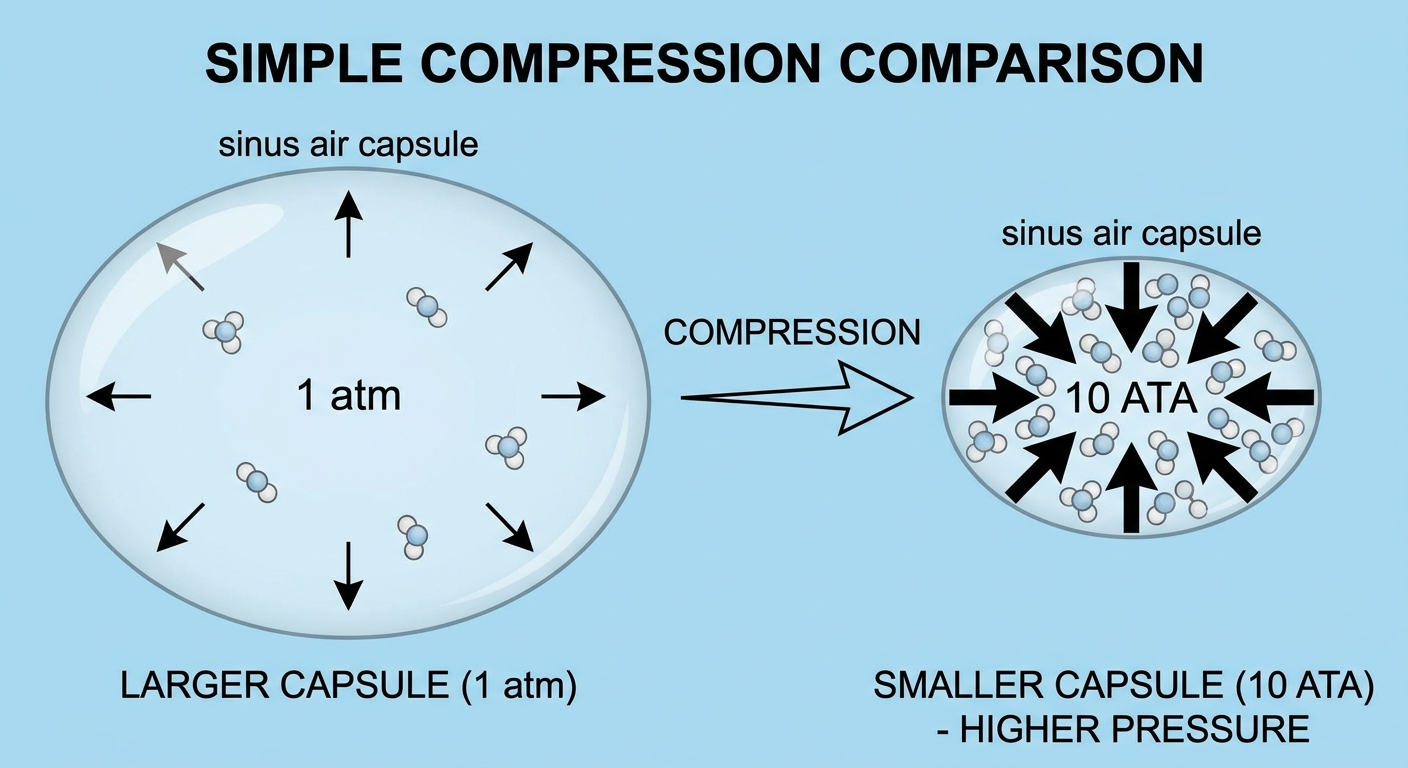
The simple idea: pressure increases as you go deeper. An atmosphere (atm) is a unit of pressure. At sea level, you’re at about 1 atm. Underwater, ambient pressure rises quickly with depth, and that pressure compresses air spaces in the body unless they can equalize.
At around 10 atmospheres of absolute pressure (ATA), you’re roughly near 90 meters / 300 feet in seawater—a depth typically associated with technical diving rather than casual recreational dives. Exact depth varies slightly with water type and conditions, but the takeaway is the same: the deeper you go, the less forgiving minor airflow problems can be.
Quick comparison:
- Everyday life: ~1 atm
- Deep descents: multiple atmospheres higher, with much larger forces acting on every air-filled space
A simple analogy: imagine a small air pocket in a rigid space with a tiny valve. When outside pressure increases, the only way to keep things comfortable is to let air move through that valve. If the valve narrows—even a little—the pressure difference can build fast. In your face, the “valves” are the narrow sinus openings that connect to your nasal cavity.
At extreme pressures, very small blockages can become very big problems.
Your Nose and Sinuses Are “Air Spaces” That Must Equalize
What your sinuses do during a descent: The sinuses are small, air-filled cavities in the facial bones that connect to the nasal passages through narrow openings. As you descend, ambient pressure increases and internal air spaces need to stay in balance. When pathways are clear, small amounts of air move passively to equalize pressure. Unlike your middle ears—where divers often actively equalize—sinuses depend heavily on passive airflow through very small channels.
The key issue: blockage prevents equalization. If sinus pathways are narrowed or blocked by inflammation, mucus, polyps, recent illness, or structural issues (like a deviated septum), the sinus can act like a poorly ventilated pocket. Pressure then lags behind the environment, stressing delicate tissues.
A common pattern: On land, a partially narrowed pathway may feel like a minor nuisance. Under increased pressure—especially with a faster descent—it can be the difference between smooth equalization and sudden pain.
If air can’t move freely, pressure can’t equalize smoothly.

What Happens at High Pressure: “Sinus Squeeze” (Barosinusitis)
Definition (patient-friendly): Barosinusitis, often called sinus squeeze, occurs when pressure inside a sinus can’t keep up with rising or falling ambient pressure, irritating and injuring the sinus lining (mucosa).
Why higher pressure makes it worse: At 10 ATA, the environment is pushing hard on every air space. If a sinus can’t equalize, the pressure difference across fragile tissue can become intense. The lining may swell, small vessels can tear, and fluid or blood can leak into the sinus and sometimes out through the nose. The deeper the dive (and the faster the change), the more unforgiving a partial blockage becomes.
What kind of injury can occur:
- Mucosal inflammation and edema
- Tissue irritation or injury
- Mucosal hemorrhage, sometimes appearing as a post-dive nosebleed (epistaxis)
When equalization fails, tissue takes the load.

Symptoms to Watch For (During Descent and After Surfacing)
During descent:
- Sharp, localized facial pain (forehead, between the eyes, or cheeks—depending on the sinus)
- Pressure that escalates quickly rather than building slowly
- One-sided or focal pain that spikes at a particular depth and doesn’t improve with a pause
After surfacing:
- Blood from the nose (epistaxis)
- Persistent facial tenderness or headache
- Congestion or a “full” sensation
- Occasionally, a reduced sense of smell
If you’re also dealing with ongoing nasal irritation on land, it may be helpful to read more about chronic nosebleeds and septoplasty (https://www.clearpathnasal.com/blog/can-septoplasty-help-with-chronic-nosebleeds).
When symptoms are an emergency, seek urgent evaluation (ER or ENT) for:
- Severe or one-sided pain that does not improve
- Heavy or persistent bleeding
- Fever or worsening systemic symptoms
- Vision changes, swelling around the eye, or neurologic symptoms
New severe pain, heavy bleeding, or eye/vision symptoms deserve urgent care.
Why Divers Are Told: “Don’t Dive Congested”
DAN advises divers not to dive when congested, because congestion can interfere with equalization and raise barotrauma risk. The risk isn’t just discomfort; it also includes tissue injury and potential safety complications from pain or distraction during a dive.
If chronic stuffiness is common for you, this overview on what to do about chronic nasal congestion (https://www.clearpathnasal.com/blog/deviated-septum-and-chronic-nasal-congestion-what-to-do-next) may help you map out next steps.
Common contributors to reduced sinus ventilation include:
- Seasonal allergies
- Viral colds
- Chronic sinusitis/inflammation
- Structural narrowing (including a deviated septum)
Congestion increases risk because blocked air can’t equalize.

Who Is Most at Risk at 10 ATA (and Other High-Pressure Settings)
Technical divers and deep descents: Around 10 ATA (~90 m / 300 ft in seawater), divers face larger pressure changes across air spaces, longer exposures, and higher task loads—factors that make it harder to respond calmly to sudden pain or bleeding even with excellent training and equipment.
Other high-pressure environments: Sinus barotrauma can occur in other settings involving pressure changes (for example, hyperbaric environments).
The deeper and busier the profile, the less margin there is for any airway limitation.
How to Lower Your Risk Before You Enter a High-Pressure Environment
Do a practical nose-and-sinus check before diving: As a general rule, if nasal breathing is clearly blocked on land, it may not improve under pressure. A prior episode of sinus squeeze is a useful risk signal to address before deeper or more complex dives.
Address underlying nasal obstruction (the longer-term approach): If congestion is frequent or equalization is unreliable, consider a medical evaluation for allergic or chronic inflammation, recurrent sinus infections, or structural narrowing (such as a deviated septum). For background on chronic stuffiness and possible next steps, see what to do about chronic nasal congestion (https://www.clearpathnasal.com/blog/deviated-septum-and-chronic-nasal-congestion-what-to-do-next).
When to see an ENT (helpful triggers):
- Recurrent facial pressure or headaches
- Frequent sinus infections
- Chronic mouth breathing or snoring
- Repeated nosebleeds
- A prior history of sinus barotrauma
Reliable airflow on land makes equalization more reliable at depth.
If You Have a Deviated Septum: Why Better Nasal Airflow Can Matter
How a deviated septum can contribute: A deviated septum can narrow one side of the nose and contribute to turbulence, dryness, and congestion. For divers, structural narrowing may also limit how effectively the nasal passages support sinus ventilation and drainage—potentially making “sinus squeeze” more likely if equalization pathways are tight. For background, see deviated septum symptoms and treatment options (https://www.clearpathnasal.com/blog/deviated-septum-explained-symptoms-causes-and-modern-treatment-options).
Procedure education (non-promotional): If you’re exploring minimally invasive approaches, this plain-language overview of balloon septoplasty (https://www.clearpathnasal.com/blog/what-is-balloon-septoplasty-a-minimally-invasive-option-for-deviated-septum) explains one technique some clinicians may discuss when septal deviation contributes to obstruction.
Evidence snapshot (limited and informational): A single retrospective analysis of force-directed, balloon-assisted endoscopic septoplasty using a specific device reported improvements in CT-based septal alignment and in patient-reported symptoms (SNOT-22), with no major complications in that cohort (Dillard J, Koudouovoh C, Lee V, et al., 2026; Rhinology Online). Results from a single study may not apply to all patients, and techniques/devices vary by clinician and indication.
Structural airflow matters, but treatment decisions are individualized and evidence is still evolving.

What to Do If You Suspect a Sinus Squeeze
Stop—don’t “push through” severe pain: If sharp, localized facial pain starts or worsens on descent, treat it as a warning sign. Continuing deeper can increase tissue stress and injury risk. DAN’s educational materials emphasize taking symptoms seriously rather than forcing equalization.
After the dive: document and consider evaluation. Helpful notes include:
- Maximum depth (especially if approaching higher absolute pressures)
- When symptoms started (descent vs ascent)
- Which side hurt
- Whether there was bleeding, congestion, or reduced smell
What a clinician may consider (high level):
- Focused history and nasal exam
- Assessment for inflammation or structural blockage
- Imaging in more severe or recurrent cases
- Individualized medication or procedural options when indicated
Early attention to symptoms can reduce the chance of repeat injury.
Key Takeaways
- Around 10 atmospheres of absolute pressure (~90 m / 300 ft in seawater), small airflow limitations can have large effects on sinus air spaces.
- If the sinuses can’t equalize due to blockage, sinus squeeze (barosinusitis/sinus barotrauma) can cause severe facial pain on descent and post-dive nosebleeds.
- DAN advises divers not to dive when congested because congestion can interfere with equalization and raise barotrauma risk.
- If persistent obstruction is part of your history (including a deviated septum), consider an ENT evaluation to discuss appropriate options—medical or surgical, including septoplasty if indicated.
References
- Divers Alert Network (DAN). Sinus Barotrauma. https://dan.org/health-medicine/health-resources/diseases-conditions/sinus-barotrauma/
- NCBI Bookshelf. Barosinusitis / sinus barotrauma (clinical overview). https://www.ncbi.nlm.nih.gov/books/NBK500034/
- PubMed Central (PMC). Sinus barotrauma review/article. https://pmc.ncbi.nlm.nih.gov/articles/PMC6100644/
- Dillard J, Koudouovoh C, Lee V, et al. Outcomes of force-directed balloon-assisted endoscopic septoplasty: a retrospective analysis with a new technique and device. Rhinology Online. 2026;9:18–23. doi:10.4193/RHINOL/25.018
“This article is for educational purposes only and is not medical advice. Please consult a qualified healthcare provider for diagnosis and treatment.”

Dr. David G. Dillard
Author
Share it with others!