

Safety First: How ClearPath Helps Reduce Balloon Slippage
When you’re considering a minimally invasive nasal procedure, it’s natural to ask how the balloon stays exactly where it should—especially at the moment of inflation. In balloon-assisted techniques, stability matters because the goal is controlled, targeted change. If you’re new to these approaches, this quick primer on balloon-assisted septoplasty can help frame the discussion: https://www.clearpathnasal.com/blog/what-is-balloon-assisted-septoplasty
ClearPath is designed to help reduce balloon slippage by combining multiple safeguards that support accurate placement and steady inflation—so positioning can be verified before pressure is applied. (Source: ClearPath Nasal Balloon System Official Website, 2025: https://www.clearpathnasal.com/)
Key takeaways: How ClearPath supports stable positioning
ClearPath addresses stability across the entire workflow:
- Non-elastic balloon catheter designed to help resist shifting during inflation
- Precision placement tools (including a reusable stainless-steel spatula/guide and optional guidewire support)
- Controlled, directional hydrostatic pressure (fluid-based pressure applied gradually and in a guided way)
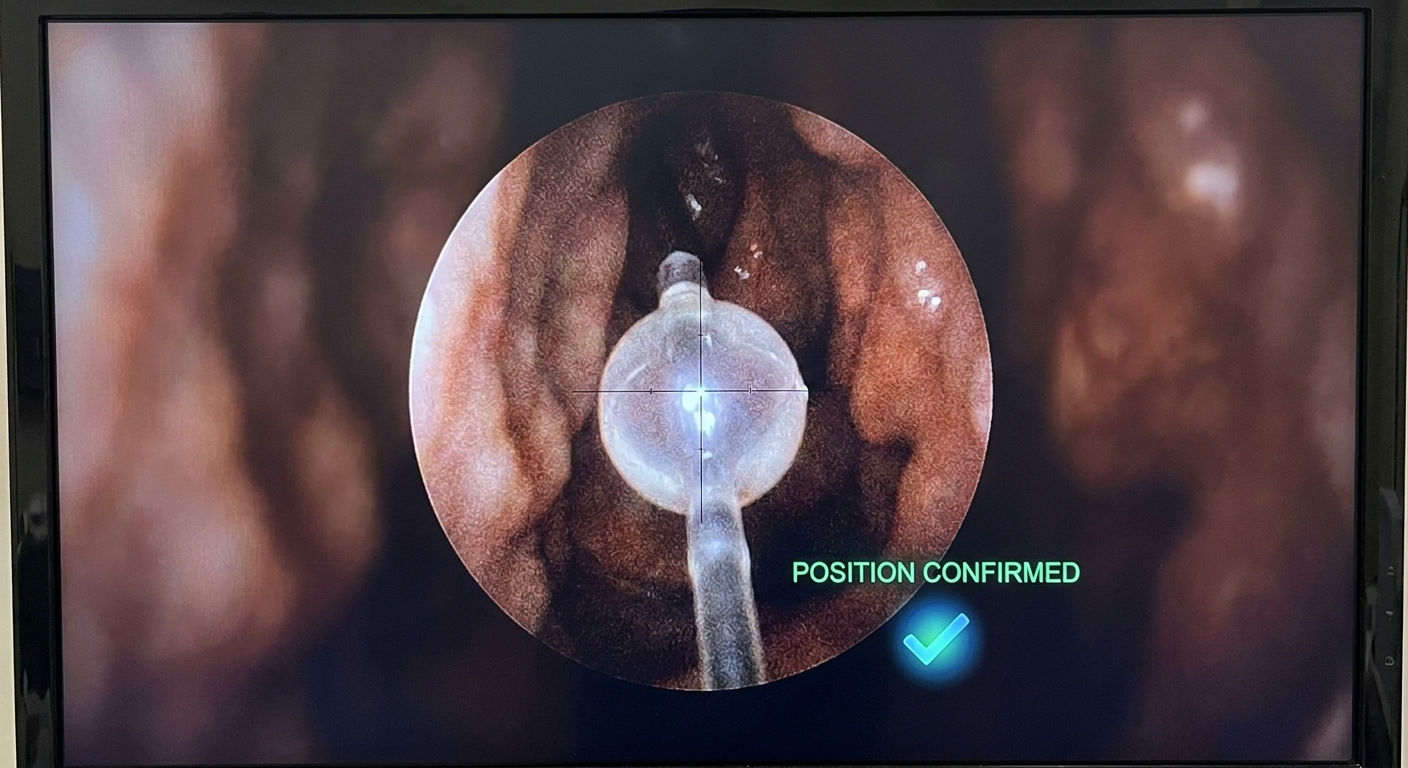
- Endoscopic visualization to confirm position before inflation
In practice, stability comes from a stack of checks—tooling, technique, and visualization—so the balloon is guided into position, confirmed, and then inflated with control. (Sources: https://www.clearpathnasal.com/ | https://www.clearpathnasal.com/blog/a-minute-by-minute-walkthrough-of-your-clearpath-nasal-balloon-procedure | http://clearpathnasal.com/faqs) – In short, ClearPath layers design and technique to support stable, controlled dilation.
Why “balloon slippage” matters in nasal balloon procedures
Balloon-based approaches are all about precision. Whether you’re seeking help for nasal obstruction or evaluating options related to septal deviation, it’s reasonable to ask how clinicians keep pressure focused on the intended area—not somewhere else.
What balloon slippage means (in simple terms)
“Balloon slippage” refers to the balloon shifting away from the planned spot before or during inflation. Even small shifts can change where pressure is applied.
Why stable positioning affects safety and results
Stable positioning supports two key goals:
- Better targeted correction: When the balloon stays where it’s placed, the dilation is more likely to focus on the intended tissue.
- Controlled tissue movement: More controlled change may help reduce the risk of unintended tissue contact or trauma.
This is why nasal balloon procedure safety isn’t only about inflation—it’s also about how the device is guided, confirmed, and stabilized first. (Source: ClearPath Nasal Balloon System Official Website, 2025: https://www.clearpathnasal.com/) – Bottom line: verified placement before inflation helps keep the procedure focused on the intended site.
Who might worry about slippage the most
You may be especially interested in stability if you:
- Have long-term nasal blockage and suspect a deviated septum
- Are comparing minimally invasive approaches (such as balloon-assisted septal dilation or balloon-assisted septoplasty) with traditional surgery
- Have anatomy that has been described as narrow, complex, or previously operated on
In consults, patients often ask: “How do you make sure the balloon is in the right place before you inflate it?” ClearPath’s workflow is designed to support placement verification before inflation. (Source: https://www.clearpathnasal.com/) – If you’re evaluating options, ask how your provider confirms placement prior to inflation.
The ClearPath approach: designed for stable placement from the start
A central theme of the ClearPath Nasal Balloon System is that stability is addressed proactively. The technique focuses on reaching the correct location first—then inflating in a controlled way. This “position first, inflate second” approach is intended to help minimize drift during inflation. – The emphasis is on confirm, then inflate.

Key feature #1: A non-elastic balloon catheter that resists shifting during inflation
Balloon movement can be influenced by how the catheter behaves as pressure increases. ClearPath addresses this through material and design choices.
Why “non-elastic” matters: ClearPath uses a non-elastic balloon catheter designed for controlled expansion. In practical terms, this design aims to support consistent, targeted inflation at the treatment site.
What patients may notice because of this design:
- More controlled dilation where it’s intended
- A design that may help reduce unintended movement during inflation
(Source: ClearPath Nasal Balloon System Official Website, 2025: https://www.clearpathnasal.com/) – The catheter is built to expand in a controlled way to support steady positioning.

Key feature #2: Precision placement tools that help minimize slippage before inflation
Much of balloon stability is decided before inflation—specifically, how accurately the catheter is guided into position.
The reusable stainless-steel spatula (guide) for accurate placement: ClearPath includes a reusable stainless-steel guide (spatula) that helps clinicians place the catheter consistently along the nasal floor and septum. For more on why this tool matters in septoplasty, see: https://www.clearpathnasal.com/blog/why-we-use-a-stainless-steel-guide-in-septoplasty
Optional guidewire support (when anatomy is complex): ClearPath includes a lumen that allows optional guidewire use to support accurate placement in more complex anatomy. The guidewire can act as a track to help the catheter follow the intended path.
Why this matters for safety: When placement is reliable before inflation, there’s less chance of the balloon migrating as inflation begins. This is one reason ClearPath’s system-level approach is intended to help minimize slippage. (Sources: https://www.clearpathnasal.com/ | ClearPath FAQs, 2025: http://clearpathnasal.com/faqs) – Accurate guidance at the start supports stability when pressure is applied.

Key feature #3: Controlled, directional hydrostatic pressure (not abrupt force)
Inflation pressure matters—and so does how it is applied.
What “hydrostatic pressure” means in everyday language: Hydrostatic pressure is pressure created by fluid in a closed system. In simple terms, it can be applied smoothly and gradually, which helps the clinician control both timing and direction.
How ClearPath uses controlled, directional pressure: ClearPath is designed for controlled, directional hydrostatic pressure to mobilize targeted nasal structures such as the septum and, when appropriate, the inferior turbinates. For a deeper dive, see: https://www.clearpathnasal.com/blog/the-science-of-hydrostatic-pressure-in-nasal-surgery
Patient takeaway: The overall intent is to support a minimally invasive approach with more predictable tissue movement and without relying on abrupt or uneven force. (Sources: https://www.clearpathnasal.com/ | ClearPath Blog, 2025: https://www.clearpathnasal.com/blog/) – The goal is steady, guided force application to help maintain control during dilation.

Safety check built in: endoscopic visualization confirms position before inflation
Even with good tools, confirmation is key. Using endoscopic visualization, the clinician can: verify catheter guidance along the nasal floor and septum, and confirm that the balloon sits at the intended location before any inflation.
Seeing the placement helps reduce reliance on “feel” alone and may lower the risk of off-target inflation. This confirmation step is one way ClearPath is designed to help reduce balloon slippage as part of a safety-first workflow. (Source: ClearPath Blog walkthrough, 2025: https://www.clearpathnasal.com/blog/a-minute-by-minute-walkthrough-of-your-clearpath-nasal-balloon-procedure) – Visual confirmation helps keep the dilation focused on the intended site.
What research says about outcomes and complications (ClearPath-assisted technique)
Looking at published data can be helpful context, with the caveat that study designs and patient populations vary.
Study size and what was measured
In a retrospective cohort of ClearPath Nasal Balloon (CNB)-assisted septoplasty:
- 107 consecutive cases were reviewed
- 23 patients had pre- and postoperative CT scans
- 43 patients completed SNOT-22 symptom surveys (a standardized sinonasal quality-of-life questionnaire)
(Source: Dillard J, Koudouovoh C, Lee V, et al. Rhinology Online. 2026;9:18–23. doi:10.4193/RHINOL/25.018)
CT imaging changes in this cohort
Among the subset with imaging, the authors reported mean symmetry improvements of:
- 22% at the nasolacrimal duct (NLD) level
- 45% at the point of maximal deviation (PMD)
(Source: Dillard et al., 2026)
Patient-reported symptom changes (SNOT-22)
Among the subset who completed SNOT-22:
- Scores improved from 58.7 to 44.8 at one month
- A 23.8% reduction, with larger gains in nasal congestion, headache/facial pressure, and sleep-related items
(Source: Dillard et al., 2026)
Safety findings in this cohort
The authors reported no major intraoperative or postoperative complications, including no septal perforation, hematoma, mucosal injury, infection, synechia, or conversion to traditional septoplasty. (Source: Dillard et al., 2026)
Patients with more severe baseline deviation
Among patients with >10 mm baseline deviation, 78% (18/23) achieved at least 30% improvement in alignment. (Source: Dillard et al., 2026)
Important limitations
These findings reflect a single-arm, retrospective cohort with subset imaging and survey data and do not establish outcomes for all patients or prove superiority to other techniques. – Consider these results as early cohort data, not guarantees of individual outcomes.
What you can do as a patient to support safe, accurate placement
Good consults make the process clear and invite questions. Consider asking:
- Will you verify placement with endoscopic visualization before inflation?
- Do you use a guidewire in complex anatomy, and how do you decide when?
- How do you determine the correct position along the septum and nasal floor?
- Based on my anatomy and symptoms, is ClearPath an option to discuss?
Also share information that could affect planning:
- Prior nasal procedures or injuries
- Long-standing congestion patterns (one side vs both)
- Sleep concerns that might relate to airflow
For broader context on recovery and comparisons, you may find this overview helpful: https://www.clearpathnasal.com/blog/clearpath-vs-traditional-septoplasty-recovery-safety-results – The aim of the consult is alignment: stable positioning, controlled dilation, and realistic expectations.
FAQs: ClearPath balloon stability and safety
Can the balloon move once inflation begins?
Any balloon-based system benefits from strong stabilization. ClearPath includes a non-elastic balloon catheter, precision placement tools, and endoscopic visualization to help minimize movement and support stable positioning. (Sources: https://www.clearpathnasal.com/ | http://clearpathnasal.com/faqs)
Does the surgeon “see” where the balloon is placed?
ClearPath-supported technique includes endoscopic visualization, allowing the clinician to visually confirm placement before inflation. (Source: ClearPath walkthrough, 2025: https://www.clearpathnasal.com/blog/a-minute-by-minute-walkthrough-of-your-clearpath-nasal-balloon-procedure)
Is ClearPath used only for the septum, or also for turbinates/nasal obstruction?
ClearPath is used to address nasal obstruction concerns involving the septum and, when appropriate, the inferior turbinates—both of which can contribute to airflow limitation. (Sources: https://www.clearpathnasal.com/ | https://www.clearpathnasal.com/blog/)
How does this compare with traditional septoplasty risks and recovery?
Every procedure has its own considerations. For a side-by-side discussion of recovery, safety, and results, see: https://www.clearpathnasal.com/blog/clearpath-vs-traditional-septoplasty-recovery-safety-results – Discuss with a qualified ENT provider which option aligns with your anatomy, symptoms, and goals.
Conclusion: Stability is a safety feature—not an afterthought
In balloon-based nasal procedures, stability supports both safety and results. ClearPath is designed to help reduce balloon slippage by layering safeguards: 1) A non-elastic balloon catheter to support controlled expansion 2) A stainless-steel guide for consistent placement plus an optional guidewire lumen for complex anatomy 3) Controlled, directional hydrostatic pressure for guided tissue mobilization 4) Endoscopic visualization to confirm positioning before inflation
ClearPath may be an option to discuss with a qualified ENT provider, depending on individual anatomy and symptoms. (Source: ClearPath Nasal Balloon System Official Website, 2025: https://www.clearpathnasal.com/) – Stable placement plus controlled inflation underpin ClearPath’s safety-first approach.
References
- ClearPath Nasal Balloon System Official Website, 2025. https://www.clearpathnasal.com/
- ClearPath Blog: Minute-by-minute walkthrough, 2025. https://www.clearpathnasal.com/blog/a-minute-by-minute-walkthrough-of-your-clearpath-nasal-balloon-procedure
- ClearPath FAQs, 2025. http://clearpathnasal.com/faqs
- Dillard J, Koudouovoh C, Lee V, et al. Outcomes of force-directed balloon-assisted endoscopic septoplasty: a retrospective analysis with a new technique and device. Rhinology Online. 2026;9:18–23. doi:10.4193/RHINOL/25.018
This article is for educational purposes only and is not medical advice. Please consult a qualified healthcare provider for diagnosis and treatment.

Dr. David G. Dillard
Author
Share it with others!


