Understanding the “Non‑Compliant” Balloon
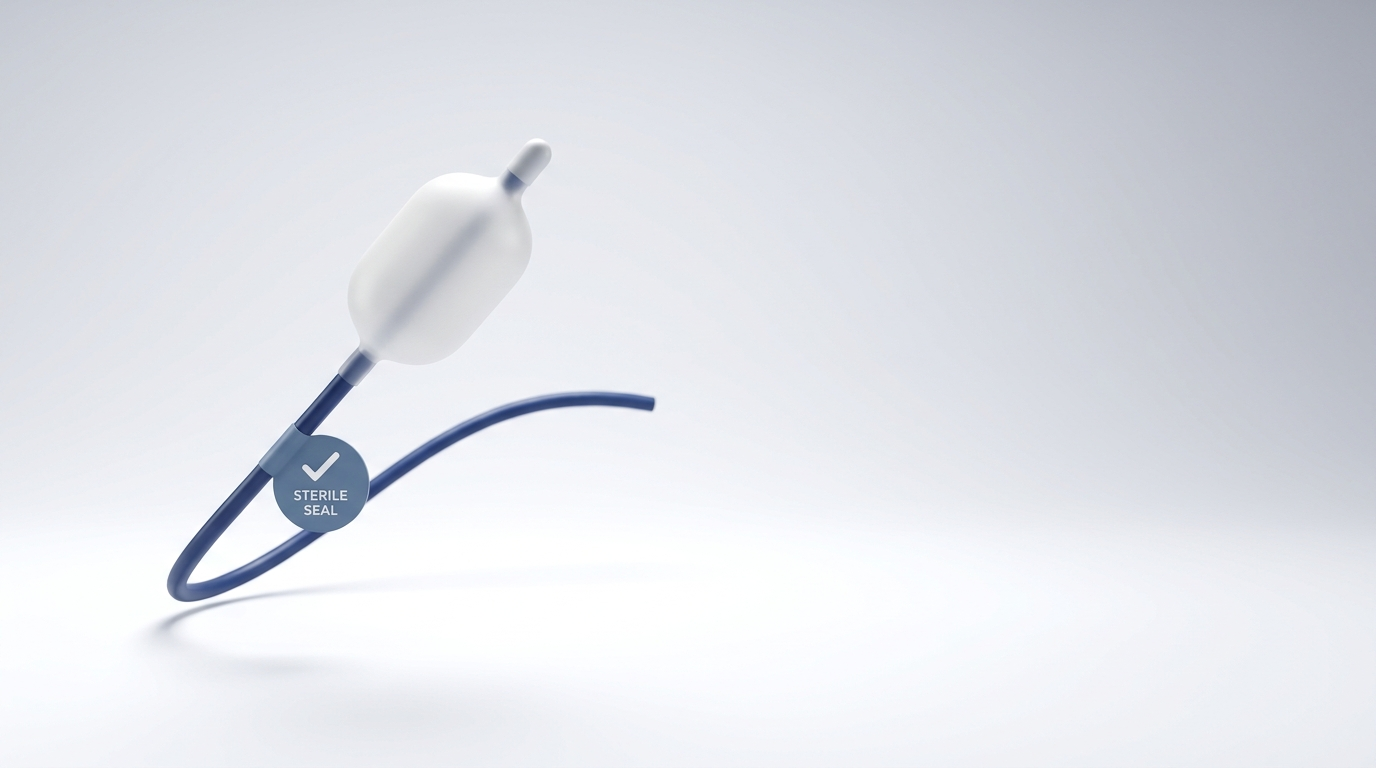
If you’re researching balloon-based procedures—especially in delicate anatomy like the nose—you may run into the term non-compliant balloon. It can sound technical, but the idea is simple: it’s about control. Specifically, it’s about using a balloon engineered to expand predictably to a target diameter with limited additional expansion as pressure increases.
A helpful way to think about it is like using a cookie cutter instead of freehand shaping: you’re aiming for a repeatable, intended result rather than “whatever happens” as pressure increases.
Below is a patient-friendly guide to what “non-compliant” means, how it differs from other balloon types, and why predictable sizing and controlled dilation are often part of procedural planning—including in balloon septoplasty using a nasal balloon catheter such as ClearPath (a medical device).

What does “non-compliant” mean in a medical balloon?
In plain English, a non-compliant balloon is engineered to expand predictably to a target diameter with limited additional expansion as pressure increases. “Non-compliant” refers to minimal stretch in the balloon material. That minimal stretch helps make sizing more predictable during a procedure. (Quasar Medical, 2025; Synergy Surgical)
Patient takeaway: Non-compliant designs are used when clinicians want more confidence that “the balloon size we planned for” closely matches the size delivered in the body.
A quick analogy: diameter is the “size,” pressure is the “push”
If you’ve ever inflated a bike tire, you’ve felt that adding pressure increases firmness. But the tire doesn’t keep getting wider forever—its construction limits the diameter. Non-compliant balloons follow a similar concept: the device is designed so the diameter is constrained, while pressure can still be used to deliver a controlled outward “push.” (Quasar Medical, 2025)
Compliant vs. semi-compliant vs. non-compliant (quick comparison)
- Compliant balloons: Tend to expand more as pressure rises (more “stretch”).
- Semi-compliant balloons: Some controlled growth with pressure, but less than compliant designs.
- Non-compliant balloons: Intended to reach a target diameter with less unintended growth at higher pressures. (Quasar Medical, 2025; Synergy Surgical)

Why clinicians care: Precision and repeatability—especially when millimeters matter.
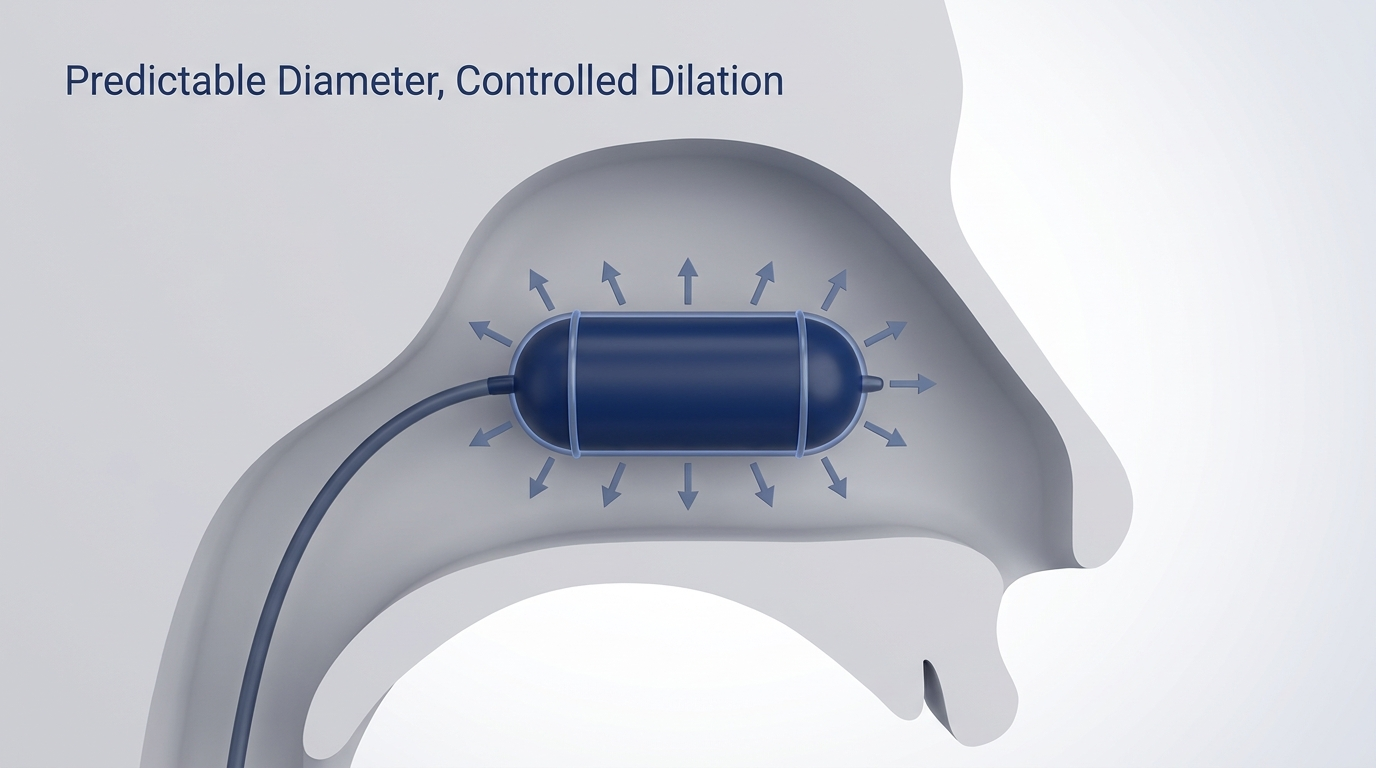
Predictable sizing and controlled dilation help when millimeters count.
Why “pressure” doesn’t automatically mean “bigger”
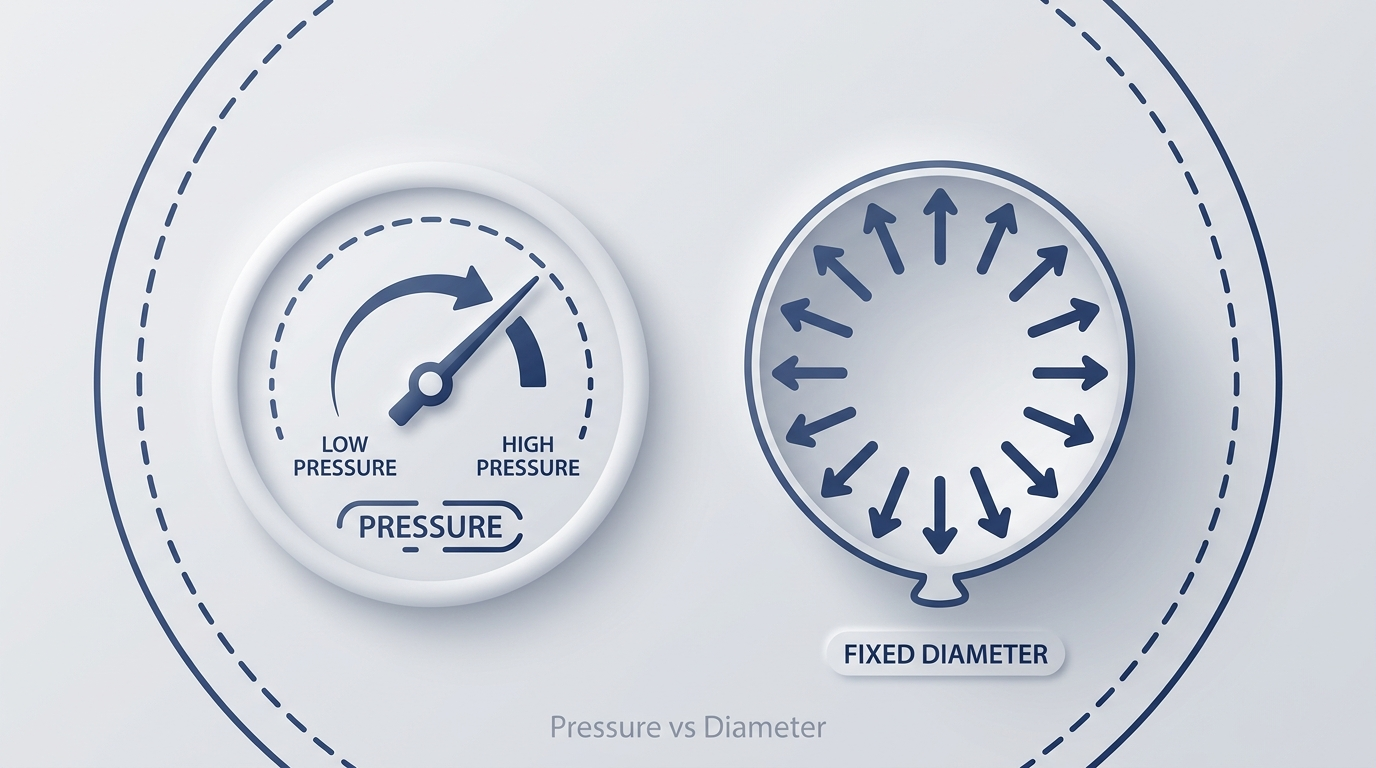
It’s natural to assume that higher pressure always makes a balloon larger. But pressure and diameter aren’t the same thing:
- Pressure helps deliver force to the surrounding tissue.
- Balloon design (compliant, semi-compliant, or non-compliant) influences how much the balloon diameter changes as pressure increases.
In other words, higher pressure can be used to deliver effective force while the balloon’s diameter remains more controlled—a key concept behind a predictable-diameter approach. (Quasar Medical, 2025)
Plain takeaway: Non-compliant balloons aim for predictable diameter with limited extra growth, allowing force to be applied in a controlled way.
Why a precise balloon diameter can matter for outcomes
Across medical uses of balloon technology, predictable sizing tends to matter for three practical reasons:
- Predictability: Clinicians can target a planned size rather than guessing how much the balloon might grow.
- Consistency: A controlled, known diameter can help produce more uniform expansion—especially important in delicate anatomy.
- Control: Reducing unintended over-expansion is often part of procedural planning when working near sensitive structures. (Quasar Medical, 2025; Synergy Surgical)
This is why the phrase controlled dilation comes up so often in patient education: it’s about shaping or repositioning tissue in a measured way—not simply “stretching as much as possible.” For more on why this approach matters, see the benefits of controlled tissue displacement: https://www.clearpathnasal.com/blog/the-benefit-of-controlled-tissue-displacement.
The role of radial force (in patient-friendly terms)
Radial force is the outward force a balloon applies as it inflates—think of it as evenly distributed pressure pushing outward in a circular way.
Why it matters: when a clinician needs a structure to expand or shift in a controlled fashion, the “push” should be as even and reliable as possible. Balloon design influences how that force is delivered as pressure increases. (Quasar Medical, 2025)
A simple way clinicians describe the goal is: We want a planned diameter and a uniform outward force—not surprise growth.
Plain takeaway: Predictable diameter supports even, reliable force delivery and helps reduce unintended over-expansion.

Where you may have heard of non-compliant balloons: vascular procedures (a helpful analogy)
Many people first encounter the term non-compliant balloon when reading about vascular (blood vessel) procedures, where balloons can be used to open narrowed areas. The reason the term shows up there is the same reason it matters in other anatomy: controlled size plus consistent force can be important when precision is the goal. (Quasar Medical, 2025)
Why they’re often used for “post-dilation” (stent optimization)
In angioplasty, non-compliant balloons are commonly discussed in the context of post-dilation—an additional step used to help ensure a stent is fully and uniformly expanded against the vessel wall. Because non-compliant balloons are designed to limit diameter growth while allowing higher inflation pressures within labeled ranges, teams often use them when they want more precise sizing and reliable radial force for that final “optimization” phase. (Synergy Surgical; Medtronic)
What clinical studies suggest (high-level, patient-friendly)
In coronary interventions—especially more complex anatomy such as bifurcation lesions—some observational analyses have reported associations between non-compliant balloon use and favorable longer-term outcomes; these findings do not prove causation. (EuroIntervention, COBIS II registry)
Non-compliant balloons are also used in lower-limb angioplasty, including cases involving chronic limb-threatening ischemia, where lesion preparation and controlled dilation can be important parts of treatment strategy. (PubMed: 39126223)
Takeaway: Even though the nose and arteries are different, the principle carries over: when the plan requires precision, clinicians often choose tools built for predictable diameter and controlled force.
Plain takeaway: In settings where precision matters, devices that limit unintended diameter growth are often preferred, but study findings are context-specific and not proof of cause.
What “non-compliant” can mean in nasal balloon procedures (bringing it back to the patient)
In nasal procedures, the big idea isn’t “bigger is better.” The goal is typically measured, controlled tissue displacement—a planned change delivered in a predictable way.
With balloon-assisted septoplasty, clinicians may use a balloon catheter to apply controlled dilation to targeted anatomy. ClearPath is a nasal balloon catheter device that may be used in balloon-assisted septoplasty, depending on clinical judgment and device labeling. For a step-by-step overview, see: https://www.clearpathnasal.com/blog/how-the-clearpath-nasal-balloon-works-a-step-by-step-guide. If you’d like a deeper dive on how the technique aims to direct force, see how force-directed dilation works: https://www.clearpathnasal.com/blog/how-force-directed-dilation-changes-the-game.
Important note on terminology
Balloon systems can be designed with different compliance profiles (compliant, semi-compliant, or non-compliant). If you’re trying to understand what type is being used in your care, the best source is the device labeling and your clinician’s explanation of expected balloon diameter at the labeled inflation pressures.
Why controlled dilation is often discussed in safety terms
When clinicians emphasize controlled dilation, they’re usually aiming for:
- Consistent technique (doing the same planned steps each time)
- Repeatable positioning (placing the balloon where intended)
- Minimizing unnecessary trauma that could occur with unintended over-expansion
This is also why “pressure” is often explained alongside “diameter.” Pressure may be part of delivering the intended effect, but predictable sizing helps keep the plan consistent. Related reading: https://www.clearpathnasal.com/blog/why-10-atmospheres-of-pressure-matters-for-your-nose.
Plain takeaway: In the nose, the focus is planned, controlled change—using predictable sizing and careful technique to support consistency.
What does the evidence show for balloon-assisted septoplasty (ClearPath-relevant outcomes)
Beyond definitions, many patients want to know one thing: what do outcomes look like? A published retrospective review evaluated outcomes of force-directed balloon-assisted endoscopic septoplasty using a new technique and device approach. (Dillard et al., 2026)
Study size and what was measured
- 107 consecutive cases
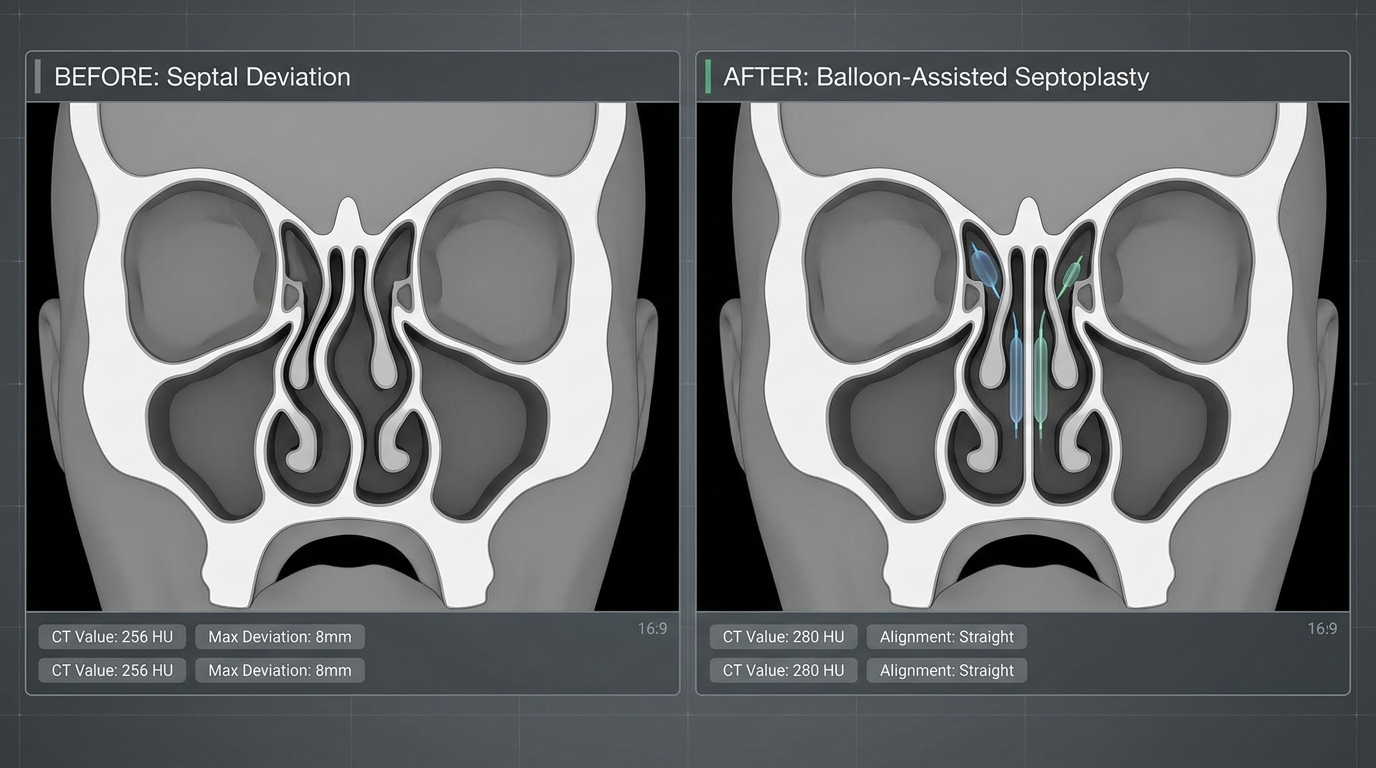
- 23 patients with pre- and post-operative CT scans (objective measurement)
- 43 patients who completed SNOT-22 symptom surveys (patient-reported outcomes) (Dillard et al., 2026)
For more on imaging context, see how CT scans are used to evaluate nasal blockage: https://www.clearpathnasal.com/blog/how-we-use-ct-scans-to-diagnose-nasal-blockages.
Septal alignment improved on CT
On CT-based measurement, mean symmetry improved by:
- 22% at the nasolacrimal duct (NLD)
- 45% at the point of maximal deviation (PMD) (Dillard et al., 2026)
In plain terms: objective alignment measures moved in a favorable direction after the procedure in the imaged subgroup.
Patient symptoms improved (SNOT-22)
Among patients who completed symptom surveys, SNOT-22 scores improved from 58.7 to 44.8 at one month—about a 23.8% reduction. The largest improvements were reported in nasal congestion, headache/facial pressure, and sleep quality. For an explainer, see the SNOT-22 symptom score: https://www.clearpathnasal.com/blog/the-snot-22-score-measuring-your-sinus-health. (Dillard et al., 2026)
Safety findings in the cohort
In this cohort, the authors reported no major intraoperative or postoperative complications, including septal perforation, hematoma, mucosal injury, infection, synechia, or conversion to traditional septoplasty. (Dillard et al., 2026)
(As always, individual risk depends on anatomy, medical history, and clinician technique—so treat published results as context for a conversation, not a guarantee.)
Who benefited most (severity subgroup)
When patients were grouped by baseline severity, the severe deviation group (>10 mm) showed the largest proportional correction. In the CT subgroup, 78% (18/23) achieved at least a 30% improvement in alignment. (Dillard et al., 2026)
Plain takeaway: In one retrospective cohort, authors reported favorable alignment and symptom measures with no major complications; individual results vary.
Common patient questions about “non-compliant” balloons (FAQ)
Does “non-compliant” mean the balloon is rigid or unsafe?
Not necessarily. “Non-compliant” describes how the balloon’s diameter behaves under pressure—it’s about controlled expansion, not a balloon being “hard” or inherently unsafe. (Quasar Medical, 2025)
If higher pressure is used, does that mean higher risk?
Higher pressure can be part of delivering controlled, effective force—but risk isn’t determined by pressure alone. Safety depends on multiple factors, including anatomy, correct sizing, device design, and clinician technique.
Will a non-compliant balloon keep expanding if the clinician inflates more?
A non-compliant balloon is intended to hold a target diameter more reliably than a compliant balloon as pressure increases, helping limit unintended diameter growth. (Quasar Medical, 2025; Synergy Surgical)
How does this relate to comfort and recovery?
Some patients may experience temporary pressure during inflation or short-term congestion or swelling afterward. Your clinician is the best source for what to expect in your specific situation and which post-procedure care steps matter most.
How to talk with your ENT about balloon options (patient checklist)
Questions to ask at your visit
- What problem is being treated, and where is it located (including severity of septal deviation)?
- What balloon characteristics matter most for my anatomy (diameter control, pressure range, technique)?
- Do you track outcomes with imaging, symptom scores, or airflow measures?
- What does recovery typically look like for your patients?
If you’re still comparing approaches, this overview may help: https://www.clearpathnasal.com/blog/what-is-balloon-assisted-septoplasty.
Discussing treatment options
If you’re exploring alternatives to traditional septoplasty, ask your ENT whether balloon-assisted septoplasty or another approach is appropriate for your specific anatomy and goals.
When to seek urgent care after any nasal procedure (brief safety note)
Seek urgent medical attention if you have heavy bleeding that won’t stop, fever, rapidly worsening or severe pain, new facial swelling, or any symptom that feels sudden or concerning—especially if it’s getting worse instead of better. Follow your clinician’s specific aftercare guidance.
Plain takeaway: Use your visit to clarify goals, sizing, technique, and follow-up; urgent symptoms should be evaluated promptly.
Key takeaways
- A non-compliant balloon is designed for predictable diameter with limited additional expansion as pressure increases.
- That diameter control can support precise, uniform controlled dilation when clinicians need consistency.
- In one retrospective cohort of 107 balloon-assisted septoplasty cases, authors reported improved alignment measures and symptom scores, with no major complications reported in that study. (Dillard et al., 2026; Quasar Medical, 2025)
References
1. Quasar Medical. Choosing the Right Balloon: Semi-Compliant vs Non-Compliant Balloons. (2025). https://quasarmedical.com/education/choosing-the-right-balloon-semi-compliant-vs-non-compliant-balloons/
2. Synergy Surgical. Compliant vs Non-Compliant Balloons (educational blog). https://synergysurgical.com/blog/compliant-vs-non-compliant-balloons
3. Dillard J, Koudouovoh C, Lee V, et al. Outcomes of force-directed balloon-assisted endoscopic septoplasty: a retrospective analysis with a new technique and device. Rhinology Online. 2026;9:18–23. doi:10.4193/RHINOL/25.018
4. EuroIntervention. Impact of non-compliant balloons on long-term clinical outcomes in coronary bifurcation lesions: COBIS II registry. https://eurointervention.pcronline.com/article/impact-of-non-compliant-balloons-on-long-term-clinical-outcomes-in-coronary-bifurcation-lesions-results-from-the-cobis-coronary-bifurcation-stent-ii-registry
5. PubMed. Non-compliant balloon use in lower limb angioplasty / chronic limb-threatening ischemia. https://pubmed.ncbi.nlm.nih.gov/39126223/
6. Medtronic. NC Euphora Noncompliant Balloon Dilatation Catheter. https://www.medtronic.com/en-us/healthcare-professionals/products/cardiovascular/coronary-balloons/nc-euphora-noncompliant-balloon-dilatation-catheter.html
Educational note and medical disclaimer
This article is for educational purposes only and is not medical advice. Please consult a qualified healthcare provider for diagnosis and treatment.
Medical disclaimer: This article is for general education and is not medical advice. Balloon devices, pressures, and procedural choices vary by anatomy and clinician technique. Always rely on your ENT (or treating clinician) for diagnosis, device-specific information, and personalized guidance.

Dr. David G. Dillard
Author
Share it with others!