

Reducing Mucoperichondrial "Flap Elevation" with ClearPath: A Less Invasive Approach to Deviated Septum Relief
Living with a deviated septum can feel like you’re always breathing through a partially blocked straw. Chronic congestion, one-sided airflow, mouth breathing, and sleep disruption can become the norm. Many people begin exploring treatment for a deviated septum when sprays and allergy care don’t fully explain—or resolve—what’s going on.
One reason septoplasty can feel intimidating is that traditional techniques commonly involve lifting the delicate lining over the septum—often called mucoperichondrial flap elevation (or elevation of the mucoperichondrial/mucoperiosteal flap). That step can increase tissue disruption and may contribute to swelling, soreness, bleeding, and (in many approaches) nasal packing afterward.
ClearPath takes a different route. The ClearPath Nasal Balloon System is an FDA-cleared device designed for use in balloon-assisted septoplasty and may help reduce the need for flap elevation in selected cases, with the goal of reducing the need for packing, extensive cutting, and sutures in appropriately selected patients. (ClearPath Nasal, 2025; Sleep and Sinus Centers of Georgia, 2025) For a plain-language overview of the approach, see: balloon-assisted septoplasty https://www.clearpathnasal.com/blog/what-is-balloon-assisted-septoplasty.
What "Flap Elevation" Means (In Plain Language)
A simple anatomy refresher: the septum and its lining
Your nasal septum is the “wall” that separates your left and right nasal passages. It’s made of cartilage and bone and is covered by a thin, important lining that carries blood supply and supports septal health. That lining is called the mucoperichondrium (over cartilage) and mucoperiosteum (over bone). For simplicity, many discussions refer to this as the septum’s “lining.”
A helpful way to picture it: if the septum is the frame, the lining is the protective layer that keeps that frame nourished and resilient.
What flap elevation is—and why it’s traditionally done
In many septoplasty techniques, the surgeon gently lifts this lining off the septal cartilage/bone to access the area that needs correction. This is mucoperichondrial flap elevation—essentially raising a flap of the lining to reach the structure underneath.
That step can be necessary in traditional surgery because it creates access for reshaping, removing, or repositioning cartilage and bone. However, because the lining is delicate, elevating it can also contribute to post-procedure tenderness, swelling, bleeding risk, and crusting. It can also be one reason nasal packing is used in some cases to support healing and control bleeding—especially when more tissue manipulation is involved. (ClearPath Nasal, 2025)
In short: flap elevation helps surgeons access the septum, but it can add to tissue disruption during recovery.

Why Reducing Flap Elevation Can Matter to Patients
Less tissue disruption can mean an easier recovery experience
When people research less invasive options, they’re often thinking about day-to-day realities: pressure, tenderness, congestion during healing, crusting, and how soon they can return to normal routines. Approaches that preserve tissue layers and reduce manipulation may align with goals like less post-procedure discomfort and a smoother early recovery, though experiences vary by individual anatomy and severity. (ClearPath Nasal, 2025)
This is where reducing flap elevation becomes a practical, patient-centered concept. It’s not just surgical jargon—it relates to how much the nasal lining is disturbed. As one clinician might explain it: “If we can achieve the correction while disturbing fewer layers, patients often find the overall experience easier.” (Illustrative; individual experiences vary.)
Nasal packing is a major "comfort factor"
Nasal packing refers to materials placed in the nose after certain procedures to help control bleeding, stabilize tissue, or reduce the risk of complications. While packing can be helpful when needed, many patients worry about how it feels, how it affects breathing, and what removal might be like.
A differentiator with ClearPath is that the device and technique are intended to reduce packing in appropriate cases, when clinically feasible. (ClearPath Nasal, 2025) For people who already feel “air hungry,” minimizing packing—when appropriate—can make the first few recovery days feel less stressful.
Bottom line: if your clinician can reduce tissue disruption and packing needs, early recovery may feel more manageable.

How ClearPath Works to Reduce (or Avoid) Flap Elevation
The core difference: adjusting alignment with controlled dilation
Traditional approaches often involve lifting the septal lining to access cartilage/bone, followed by cutting, removal, or reshaping and sutures to stabilize the result.
ClearPath is different in concept. The ClearPath Nasal Balloon System is used in balloon-assisted septoplasty to provide controlled balloon dilation that can help adjust septal alignment while potentially reducing the need for extensive tissue elevation, excision, and suturing in selected cases. (ClearPath Nasal, 2025) An analogy that can help: traditional septoplasty often “rebuilds” part of the internal framework directly; balloon-assisted approaches aim to “nudge” alignment using controlled expansion.
For a deeper educational walkthrough, see: how the ClearPath Nasal Balloon works https://www.clearpathnasal.com/blog/how-the-clearpath-nasal-balloon-works-a-step-by-step-guide.

What happens during balloon-assisted septoplasty with ClearPath (high-level overview)
Without getting into how-to details, a typical ClearPath-assisted flow may include:
1) Assessment of the deviation (location and severity matter)
2) Precise placement of the device at the targeted area
3) Controlled dilation to help shift alignment
4) Completion without extensive cutting or removal in many cases
Because the technique is designed to work with less disruption of the septal lining, it may reduce the need for steps associated with more invasive access—especially mucoperichondrial flap elevation—depending on anatomy and clinical goals. (ClearPath Nasal, 2025; Dillard et al., 2026)

What ClearPath is designed to reduce in some cases
Depending on anatomy and clinical goals, some cases may avoid:
- Mucoperichondrial flap elevation
- Cartilage excision
- Suturing
- Nasal packing (often reduced when clinically appropriate)
(Plans vary by patient; the overall intent is to minimize common sources of post-procedure discomfort.) (ClearPath Nasal, 2025)
Key idea: controlled dilation aims to achieve alignment goals while limiting tissue disturbance when suitable for your anatomy.
ClearPath vs Traditional Septoplasty (Patient-Friendly Comparison)
Invasiveness and comfort considerations
Traditional septoplasty often requires lifting the septal lining to access cartilage/bone, and it may involve cutting/removal and sutures. Those steps can be appropriate and effective, but they can also increase tissue disruption.
ClearPath-assisted septoplasty centers on controlled dilation with the goal of minimizing trauma—often aligning with reducing flap elevation and reducing packing for some patients. (ClearPath Nasal, 2025)
If you’re comparing options side-by-side, this guide may help: ClearPath vs traditional septoplasty https://www.clearpathnasal.com/blog/clearpath-vs-traditional-septoplasty-recovery-safety-results.
Takeaway: both approaches can be effective; the right fit depends on your anatomy, goals, and your ENT’s plan.
Time and recovery expectations (general, not promises)
Many patients prioritize:
- Procedure time (a shorter procedure can be practical when clinically appropriate)
- Post-procedure comfort
- Return to routine (which varies by person, anatomy, and what else is treated)
ClearPath is positioned as a less invasive approach that aims to reduce tissue disruption, which may support an easier recovery experience for some patients—without making one-size-fits-all promises. (ClearPath Nasal, 2025) If you need to plan around work, caregiving, or travel, ask not only “Will this fix the blockage?” but also “What will the first week feel like?” Your ENT can translate the technique into practical expectations for your specific anatomy.
What the Clinical Evidence Shows So Far (ClearPath-Assisted Septoplasty Outcomes)
Real-world scale: over 100 cases reviewed
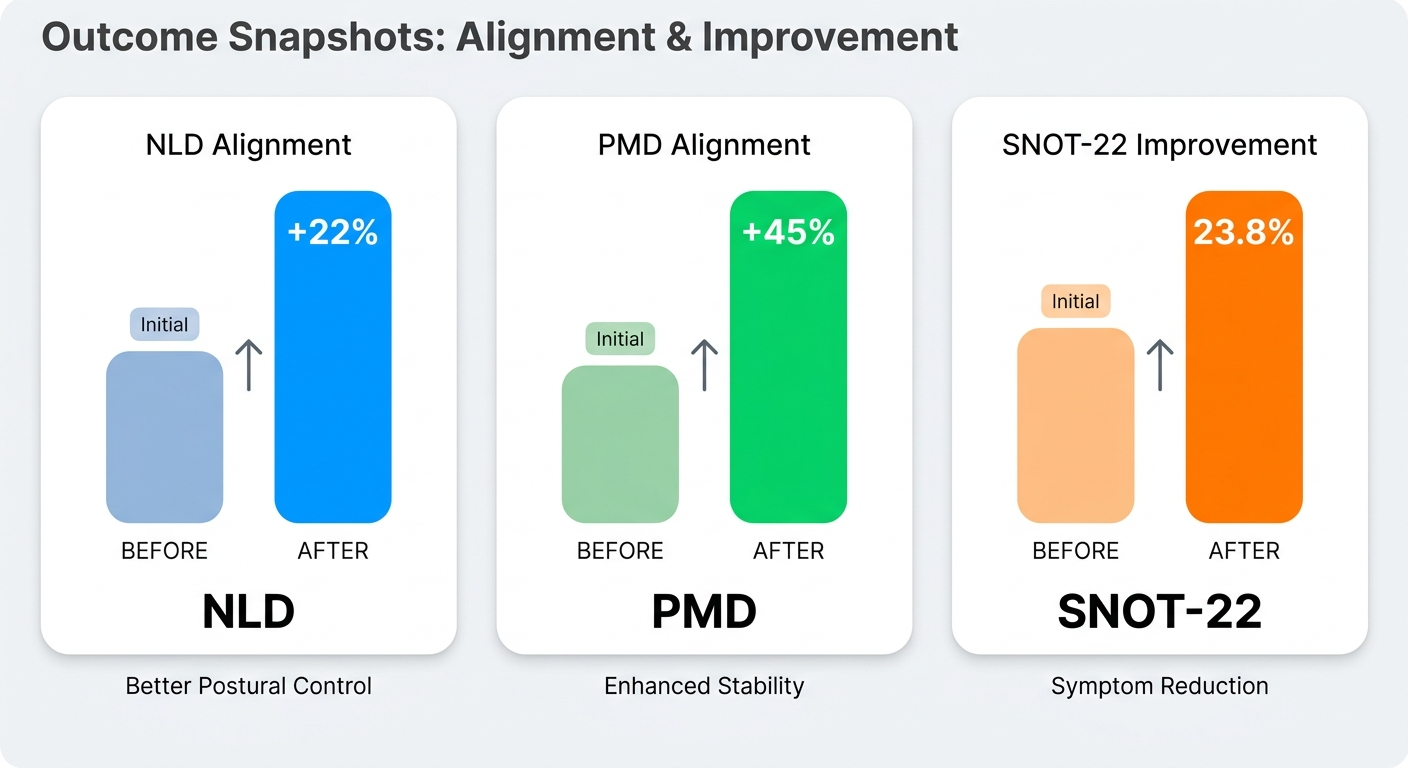
A retrospective review evaluated 107 consecutive cases using a force-directed, balloon-assisted endoscopic septoplasty technique. Among these patients, 23 had pre- and post-procedure CT scans (for objective measurement), and 43 completed symptom surveys using SNOT-22. (Dillard et al., 2026) This matters because it combines two perspectives: what imaging can measure (alignment) and what patients report (symptoms).
CT scans showed septal alignment improvements
- 22% improvement at the nasolacrimal duct (NLD)
- 45% improvement at the point of maximal deviation (PMD)
These data points help quantify what “straightening” can look like beyond a visual exam alone. (Dillard et al., 2026)
Patient symptoms improved at 1 month (SNOT-22)
In the survey subgroup, mean SNOT-22 scores improved from 58.7 to 44.8, a 23.8% reduction at one month (a 13.9-point decrease). The biggest improvements were in nasal congestion, headache/facial pressure, and sleep quality. (Dillard et al., 2026)
Safety signals in the cohort
No major intraoperative or postoperative complications were reported in this retrospective cohort, including septal perforation, hematoma, mucosal injury, infection, synechia, or conversion to traditional septoplasty. (Dillard et al., 2026)
Severe deviations may see larger proportional correction
When outcomes were stratified by baseline severity, the severe deviation group (>10 mm) showed the largest proportional improvement. In that group, 78% (18/23) achieved at least a 30% improvement in alignment. These findings suggest the technique may produce meaningful structural change in some severe deviations, though individual results vary. (Dillard et al., 2026)
Evidence summary: one retrospective series showed encouraging alignment, symptom, and safety findings; larger and longer-term studies can add helpful context over time.
Who Might Be a Good Candidate for a Less Invasive Approach?
Symptoms that suggest a structural problem (not just allergies)
- One-sided nasal blockage that persists
- Ongoing congestion not explained by seasons or triggers
- Mouth breathing (especially at night)
- Sleep disruption related to airflow limitation
An evaluation with an ENT is the best way to determine whether the septum is the main driver—or whether other issues (like swelling of the nasal lining) are contributing. A practical example: if you’ve tried allergy meds, changed bedding, and used a humidifier, but one nostril still feels consistently “closed,” it’s reasonable to ask whether structure—not inflammation—is doing most of the blocking.
Important note: not every nose is the same
Candidacy depends on anatomy, severity, and where the deviation occurs. The goal is to consider a less invasive alternative to traditional septoplasty when appropriate—but the right plan is always individualized. To explore whether this approach fits your situation, see: best candidates for balloon septoplasty https://www.clearpathnasal.com/blog/best-candidates-for-balloon-septoplasty-with-clearpath.
Practical point: an in-person nasal exam—and sometimes endoscopy or imaging—guides whether balloon-assisted techniques are a good match.
Common Questions Patients Ask About "No Flap Elevation" Septum Treatment
Does avoiding flap elevation mean it won’t work as well?
Not necessarily. The aim of reducing flap elevation is to support effective alignment while minimizing disruption to the septal lining. In the outcomes review cited above, both CT measurements and symptom scores showed meaningful improvement after balloon-assisted septoplasty. (Dillard et al., 2026)
Will I need nasal packing?
Many patients are interested in a nasal packing alternative. ClearPath is intended to reduce the need for packing in appropriate cases, when clinically feasible—though final decisions depend on your anatomy and your clinician’s plan. (ClearPath Nasal, 2025)
What does recovery feel like?
Recovery varies, but many patients should still expect some temporary congestion, mild soreness, and a short healing period. Your provider will give the best guidance on activity, nasal care, and what to watch for based on your specific case. A useful way to frame it is to ask: “What’s typical for the first 24–72 hours, and what changes in week one?”
Next Steps: How to Explore ClearPath as an Option
Questions to ask your ENT
- Am I a candidate for balloon-assisted septoplasty with the ClearPath Nasal Balloon System?
- How severe is my deviation, and where is it located?
- Will I need nasal packing?
- What recovery timeline is typical for my case?
Where to learn more
If your goal is reducing flap elevation while still pursuing meaningful breathing improvement, ClearPath may be worth discussing during your evaluation. You can also compare approaches here: ClearPath vs traditional septoplasty https://www.clearpathnasal.com/blog/clearpath-vs-traditional-septoplasty-recovery-safety-results.
Next step: bring your goals and questions to an ENT visit so you can match technique to anatomy and priorities.
FAQ (Schema-Style)
Q: Does avoiding flap elevation mean it won’t work as well?
A: Not necessarily. The aim is effective septal alignment with less disruption. A retrospective outcomes review reported meaningful CT alignment improvements and improved SNOT-22 symptom scores after balloon-assisted septoplasty. (Dillard et al., 2026)
Q: Will I need nasal packing with ClearPath?
A: In some cases, the device and technique are intended to reduce the need for nasal packing, though needs vary based on anatomy and clinician judgment. (ClearPath Nasal, 2025)
Q: What does recovery feel like after a less invasive septum procedure?
A: Experiences vary, but it’s common to have temporary congestion and mild soreness. Your ENT will provide personalized recovery guidance.
References
- ClearPath Nasal. (2025). Physician resources & FAQs. https://www.clearpathnasal.com/for-physicians ; https://www.clearpathnasal.com/faqs
- Dillard J, Koudouovoh C, Lee V, et al. (2026). Outcomes of force-directed balloon-assisted endoscopic septoplasty: a retrospective analysis with a new technique and device. Rhinology Online, 9:18–23. https://www.rhinologyonline.org/Rhinology_online_issues/manuscript_2530.pdf
- Sleep and Sinus Centers of Georgia. (2025). ClearPath overview (site reference as provided).
This article is for educational purposes only and is not medical advice. Please consult a qualified healthcare provider for diagnosis and treatment.

Dr. David G. Dillard
Author
Share it with others!


