
Many people put off fixing a deviated septum for years—not because they don’t want to breathe better, but because they’re worried about pain, nasal packing, downtime, or complications. Traditional septoplasty can be highly effective, but it can also feel like a big step if you’re balancing work, family, and recovery.
A 2026 retrospective study in Rhinology Online described a newer approach called force-directed dilation, performed with the ClearPath Nasal Balloon (CNB) device, that aims to address septal deviation with less tissue disruption than classic techniques in selected cases. In this article, you’ll learn what force-directed dilation is, how it works, what the authors reported, what recovery may look like, and what factors clinicians consider when evaluating whether it may be appropriate for a given patient.
Source: Dillard et al., 2026.
What Is “Force-Directed Dilation” (and how is it different from traditional septoplasty)?
The simple explanation (patient-friendly)
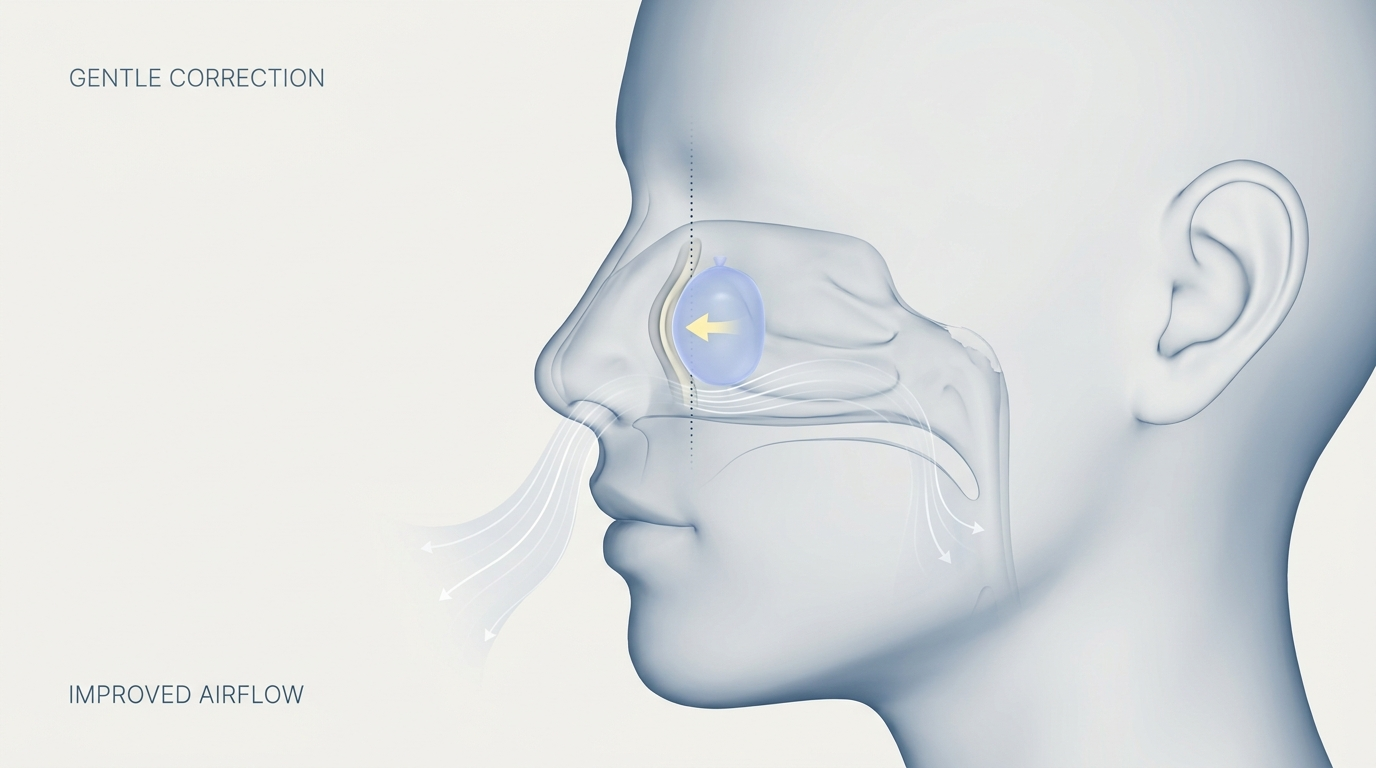
Force-directed dilation is a technique designed to mobilize and reposition a deviated septum using directional hydrostatic pressure—rather than relying mainly on cutting, removing, or extensively reshaping tissue.
In plain terms: a small balloon is guided into position, then expanded so that pressure is applied in a controlled direction to help straighten targeted segments of the septum.
A quick analogy (to make it less abstract)
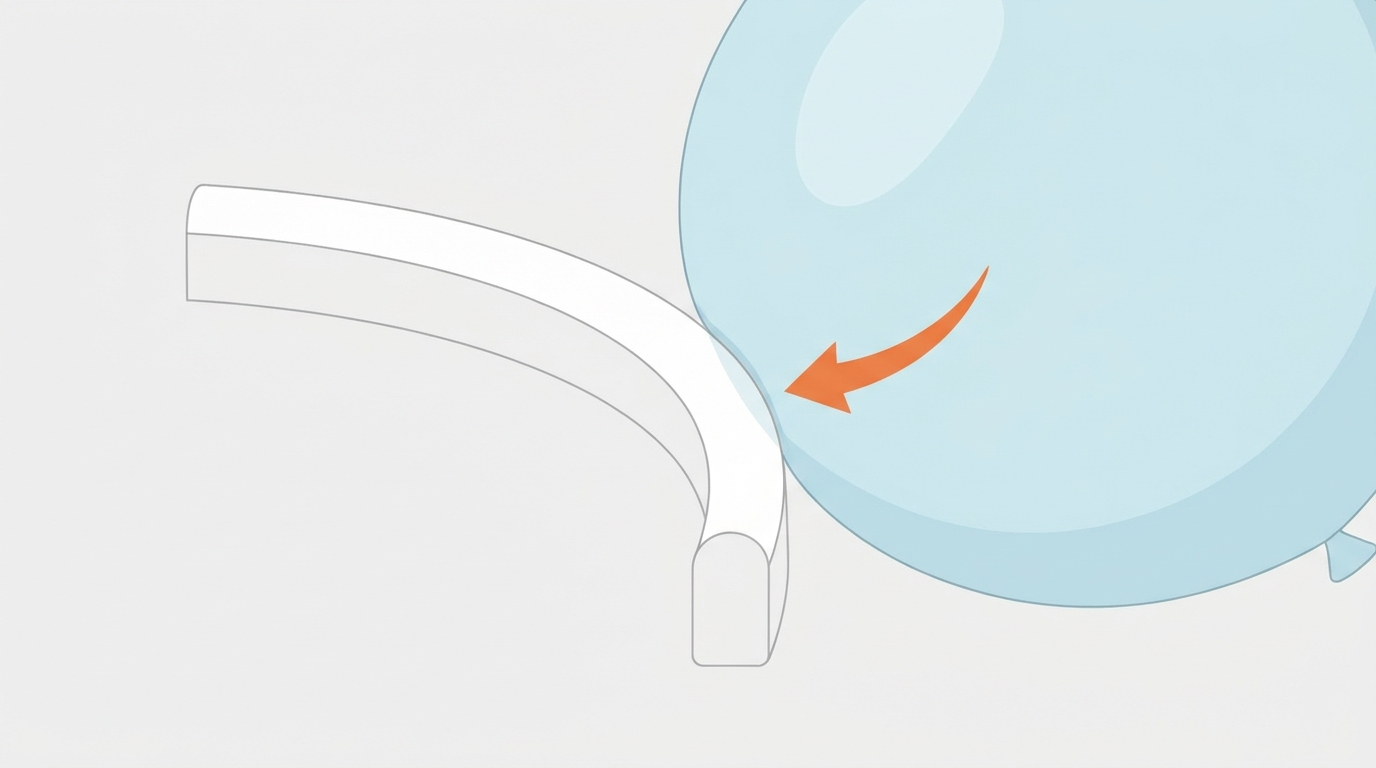
If you’ve ever tried to straighten something slightly bent—like easing a warped plastic divider back into place—you know that where you apply pressure matters as much as how much pressure you use. Force-directed dilation follows the same idea: apply corrective pressure precisely to the deviated segment, instead of working more broadly around it.
Why “force-directed” matters
“Directed” means the goal is to apply corrective pressure where the septum is deviated while limiting unnecessary stress on nearby nasal structures (such as the lateral nasal wall). In the 2026 report, this targeted approach was presented as a potential way to reduce tissue disruption compared with more invasive methods in appropriately selected patients.
Where the ClearPath Nasal Balloon (CNB) fits in
The ClearPath Nasal Balloon (CNB) is the device used in the study to deliver balloon-assisted, force-directed dilation. It’s a tool—not a medication or implant—used during the procedure to deliver controlled, directional pressure. For a deeper walkthrough, see how the ClearPath Nasal Balloon works.
In brief
Force-directed dilation uses controlled, directional balloon pressure to help reposition selected septal deviations with potentially less tissue disruption in appropriate cases.
The Problem It’s Trying to Solve: Why traditional septoplasty can feel like a big step
Common patient concerns
When people research deviated septum treatment, the hesitation is often less about the diagnosis and more about the treatment experience. Common worries include:
- Fear of significant pain or discomfort
- Concerns about bruising and swelling
- Worry about nasal packing or splints
- Time off work and reduced activity
- Anxiety about complications and prolonged recovery
Traditional septoplasty remains the right and effective option for many people, but it can involve more internal tissue work than patients expect.
What this can look like in real life (a concrete example)
A common scenario is someone who can “get by” during the day—maybe one side is always blocked, or workouts feel harder—but nights are rough. They’re tired, they snore, they wake up with dry mouth, and they think, “I should really fix this,” then wonder: Will I be out of work for a week? Will I have packing? How uncomfortable will this be?
That’s the gap minimally invasive approaches aim to narrow—when it makes medical sense to do so.
Traditional septoplasty vs minimally invasive approaches (high-level)
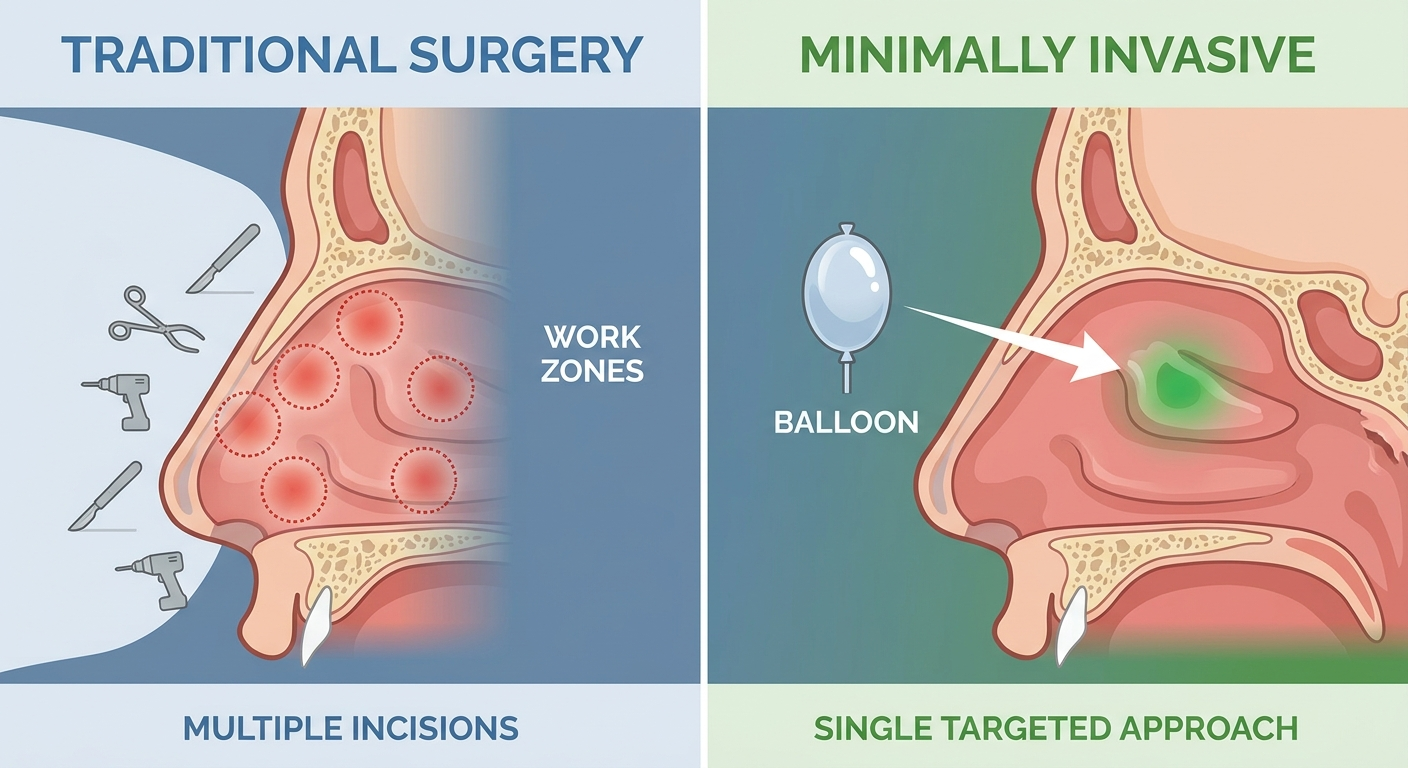
In many traditional approaches, the surgeon may need to lift the lining inside the nose (elevate a mucoperichondrial flap) to access and modify cartilage or bone. That’s not “bad”—it’s simply more invasive by nature. By contrast, force-directed dilation is intended to reduce tissue disruption by using controlled, directional pressure to reposition the septum in selected cases. If you’re comparing options, you may find this overview helpful: ClearPath vs traditional septoplasty.
Bottom line: minimally invasive options may address specific deviations with less tissue disruption, but traditional techniques remain appropriate for many anatomies and goals.
How Force-Directed Dilation Works (step-by-step, in plain English)

Step 1 — Guided placement (endoscopic visualization)
The procedure is performed with endoscopic visualization—your clinician uses a small camera to see inside the nose with precision while guiding the device into place. This supports careful positioning in a narrow, variable space.
Step 2 — Directional hydrostatic pressure to mobilize the septum
Hydrostatic pressure (fluid pressure) is used to expand the balloon in a controlled way. The goal is to apply enough pressure, in the right direction, to help mobilize and reposition the deviated portion of the septum.
Step 3 — The role of the force-directed guide/spatula
In the 2026 report, a force-directed guide/spatula was described as helping redistribute pressure during dilation. In practical terms, this component is intended to focus the corrective effect where it’s needed and limit unintended force on nearby structures.
Step 4 — What’s often not needed (varies by case)
In the study description, the approach was associated with efficiency-focused elements such as reduced anesthesia time and often no sutures or packing. Individual plans vary by anatomy, the location/type of deviation, whether additional work is needed (for example, inferior turbinate treatment), and medical history.
Takeaway
The technique centers on targeted, image-guided pressure rather than broad internal dissection, with steps tailored to the individual’s anatomy.
What the 2026 Clinical Research Shows (results patients care about)
Study design and what was measured
The 2026 publication reviewed outcomes from a retrospective series using CNB-assisted endoscopic septoplasty with force-directed dilation. Key groups included:
- 107 consecutive CNB-assisted septoplasty cases reviewed
- 23 patients with pre- and post-procedure CT scans (objective imaging subgroup)
- 43 patients who completed the Sino-Nasal Outcome Test-22 (SNOT-22) symptom surveys (patient-reported outcomes subgroup)
This design allowed the authors to assess both imaging-based alignment and symptom changes. As a retrospective series without a control group, it provides early evidence but cannot establish equivalence to traditional septoplasty.
Better alignment and symmetry (CT findings)
CT-based measures showed mean improvement in septal symmetry of:
- 45% at the point of maximal deviation (PMD)
- 22% at the nasolacrimal duct (NLD), an anatomic landmark/measurement level rather than a treatment target
In everyday language: the most crooked area saw the largest average change, with additional improvement noted at a standard measurement level on CT.
Symptom improvement patients can feel (SNOT-22)
Among patients with SNOT-22 surveys, scores improved from 58.7 to 44.8 at one month, a 23.8% mean reduction. The most improved items included nasal congestion, facial pressure/headache, and sleep quality. SNOT-22 is a standardized questionnaire that helps quantify symptom burden over time.
Who improved the most (severity matters)
Severity influenced correction: patients with severe baseline deviation (>10 mm) showed the largest proportional correction. In the CT subgroup, 78% (18 of 23) achieved at least 30% improvement in alignment.

At a glance (from the 2026 report)
- CT symmetry at PMD: 45% mean improvement
- CT symmetry at NLD: 22% mean improvement
- SNOT-22 at 1 month: 58.7 → 44.8 (23.8% mean reduction)
- At least 30% alignment improvement: 78% (18/23) in the CT subgroup
In sum
These retrospective findings are encouraging but preliminary, and confirmation in prospective, controlled studies would strengthen confidence in the results.
Safety and Complications: What makes this approach “lower trauma” in the study context?
Reduced tissue disruption (why it may be gentler)
A major theme in the report is reduced reliance on elevating the delicate inner nasal lining (mucoperichondrial flap) compared with traditional techniques in selected cases. For some patients, less disruption to that lining may translate to less bleeding, swelling, and discomfort—though experiences vary.
Complications in the 2026 cohort
In the reported cohort, no major intraoperative or postoperative complications were observed, including:
- Septal perforation
- Hematoma
- Mucosal injury
- Infection
- Synechiae (scar-tissue adhesions)
- Conversion to traditional septoplasty
Balanced note
No procedure is risk-free, and outcomes depend on anatomy, technique, and overall health. Your ENT can explain your personal risk profile.
Key point
In this retrospective series, the authors observed no major complications, but results from one cohort do not guarantee outcomes for all patients.
Recovery and Downtime: What patients can realistically expect

Why recovery may be faster for some patients
When a procedure reduces tissue disruption and often avoids packing/sutures, it may support a smoother recovery experience for selected patients. “Faster,” however, does not mean “instant”—the nose still needs time to settle.
Common short-term experiences to ask your doctor about
People often ask about the first few days. Topics to discuss with your clinician include:
- Temporary congestion (often from swelling)
- Mild tenderness or pressure
- Temporary swelling that changes day-to-day
Practical notes
For a practical resource, see this patient-friendly first 48-hour recovery checklist. Contact your surgeon promptly if you have fever, heavy bleeding, worsening pain, or breathing that suddenly gets worse.
Practical summary
Many patients can anticipate short-term swelling and congestion as tissues adapt, with activity guidance tailored by the treating clinician.
Who Might Be a Good Candidate (and who may need a different approach)
Signs a deviated septum may be impacting your life
- One-sided chronic congestion
- Mouth-breathing, especially at night
- Sleep disruption or snoring
- Recurrent sinus infections
- Facial pressure
Scenarios where minimally invasive correction may be especially appealing
Force-directed dilation may be of interest if you:
- Want to prioritize less downtime
- Hope to avoid packing when feasible
- Prefer exploring a less invasive option first, when clinically appropriate
When traditional septoplasty (or additional procedures) may still be appropriate
Some situations call for traditional septoplasty or additional nasal procedures, such as:
- Complex deviation patterns
- Structural collapse contributing to obstruction
- Significant turbinate hypertrophy requiring more extensive work
- Combined functional and cosmetic goals
Your ENT will evaluate shape, location, and structural support—not just severity—to help match approach to anatomy and goals.
Essentially
Candidacy depends on your unique anatomy and goals, so an individualized exam is key.
Where This Approach Fits in the Bigger Picture
The trend toward minimally invasive interventions
Across healthcare, there’s an ongoing shift toward interventions that aim to achieve meaningful results with less disruption. In that context, force-directed dilation is an emerging approach that may offer a potentially less invasive option in selected cases.
What this means for patients
- Having more than one reasonable option to discuss
- The possibility of addressing symptoms earlier (rather than waiting until they feel unbearable)
- A recovery experience that may be simpler in some cases—without assuming guaranteed results
Big picture
Force-directed dilation reflects a broader move toward targeted, tissue-sparing techniques, with evidence that is still developing.
Next Steps: How to explore whether force-directed dilation may be appropriate
Start with the right evaluation
Begin with an ENT evaluation that considers both:
- Your symptoms (daytime breathing, exercise tolerance, sleep)
- Your anatomy (exam and, when indicated, imaging)
Bring your symptom priorities
Before your visit, write down the top 2–3 outcomes you care about most—nasal obstruction relief, better sleep, fewer headaches/facial pressure, or improved endurance during activity. Clear priorities help match the right treatment to the right goal.
A patient-friendly, non-pushy next step
Discuss this option with a qualified ENT and ask a neutral question such as: “Based on my exam, could a balloon-assisted approach like the ClearPath Nasal Balloon be appropriate for my deviation pattern, or would a traditional septoplasty better match my anatomy and goals?”
Bottom line
An informed discussion with a qualified ENT can help align technique with your anatomy, symptoms, and recovery preferences.
Reference
1. Dillard J, Koudouovoh C, Lee V, et al. Outcomes of force-directed balloon-assisted endoscopic septoplasty: a retrospective analysis with a new technique and device. Rhinology Online. 2026;9:18–23. doi:10.4193/RHINOL/25.018. https://www.rhinologyonline.org/Rhinology_online_issues/manuscript_2530.pdf
This article is for educational purposes only and is not medical advice. Please consult a qualified healthcare provider for diagnosis and treatment.

Dr. David G. Dillard
Author
Share it with others!


