
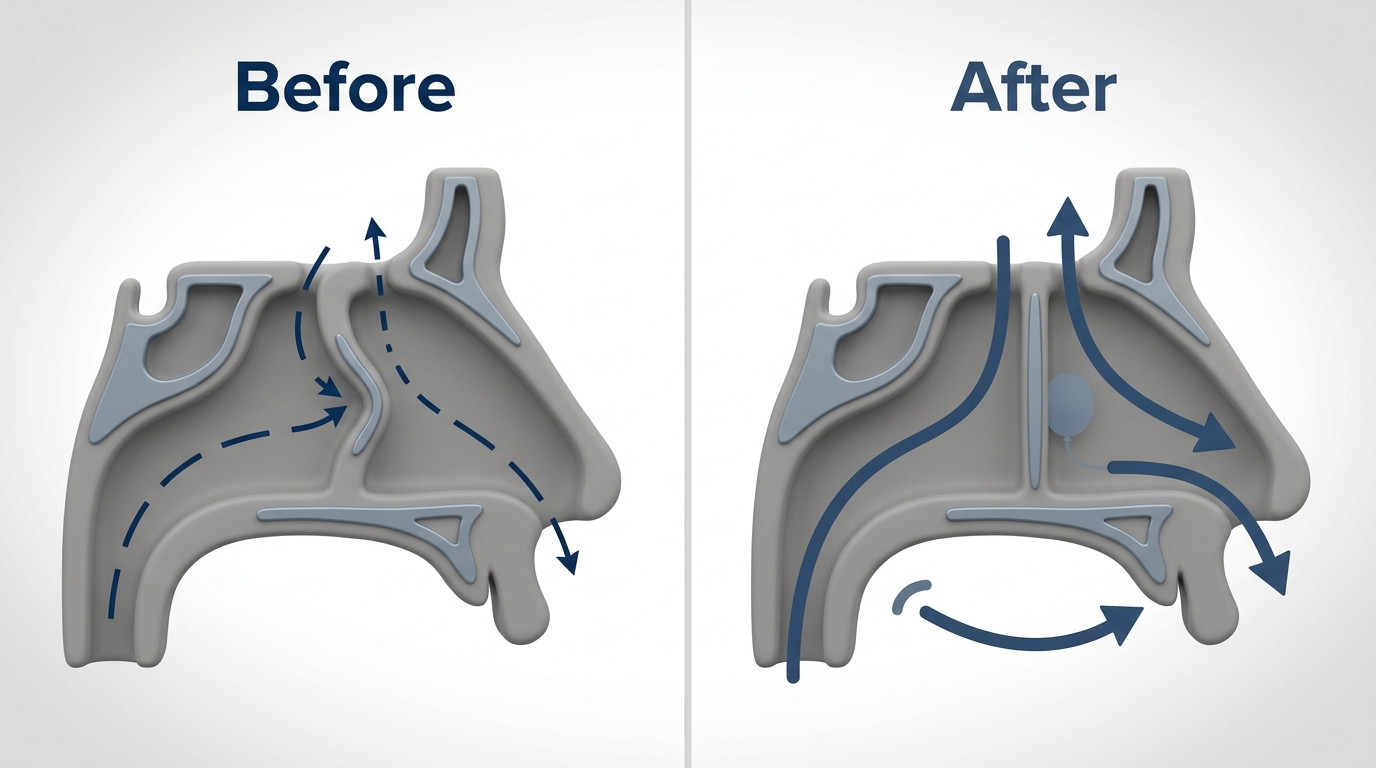
How ClearPath Mobilizes the Septum Without Cutting
If you’ve been told you have a deviated septum—or you suspect you do—you may be wondering if better nasal airflow automatically requires surgery with cutting. The ClearPath Nasal Balloon System is designed to offer another option: a minimally invasive approach intended to help mobilize and realign the septum without tissue removal by using controlled, force-directed hydrostatic pressure rather than cutting or removing tissue (1,2).
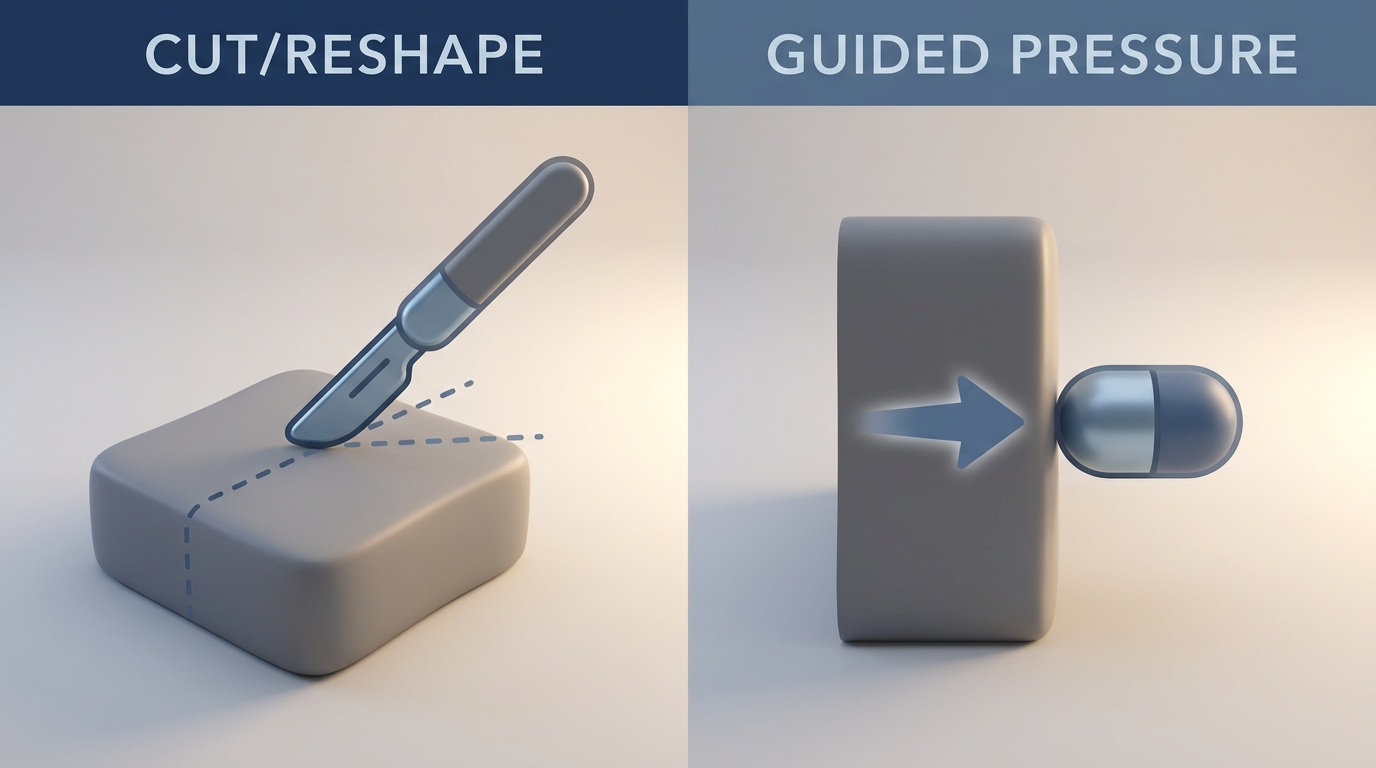
A helpful way to frame it: traditional approaches often involve cutting and reshaping tissue, while ClearPath is designed to use guided pressure to help reposition septal structures—aiming to improve airflow while preserving tissue where appropriate (1,2).
Below is a clear, patient-friendly explanation of what a deviated septum is, why sprays don’t always help, and how balloon septal mobilization with ClearPath works—plus what recovery and early evidence look like.
What a Deviated Septum Really Means (and Why It Matters)
The septum is the thin wall of cartilage and bone that divides the left and right nasal passages. When it’s off-center (deviated), airflow may be tighter on one side—or turbulent on both—making it harder to breathe through your nose.
Many patients describe it less as pain and more as a daily, low-grade limitation: you can breathe, but it never feels easy through the nose—especially when you’re lying down, exercising, or dealing with seasonal irritation.
Common symptoms patients notice
A deviated septum can show up in everyday ways, including:
- One-sided nasal blockage (or alternating blockage)
- Chronic congestion that doesn’t fully clear
- Mouth breathing (especially at night)
- Snoring or disrupted sleep
- Facial pressure or headaches
- Feeling like you can’t get enough air through your nose during exercise
Concrete examples patients often relate to
- You fall asleep on your left side and the right nostril suddenly feels completely closed.
- You try to run or climb stairs and default to mouth-breathing—even when you’re not sick.
- You use saline, sprays, and humidifiers and still feel stuck on one side most days.
If this sounds familiar, you may also find this helpful: 7 signs your nasal septum might be deviated.
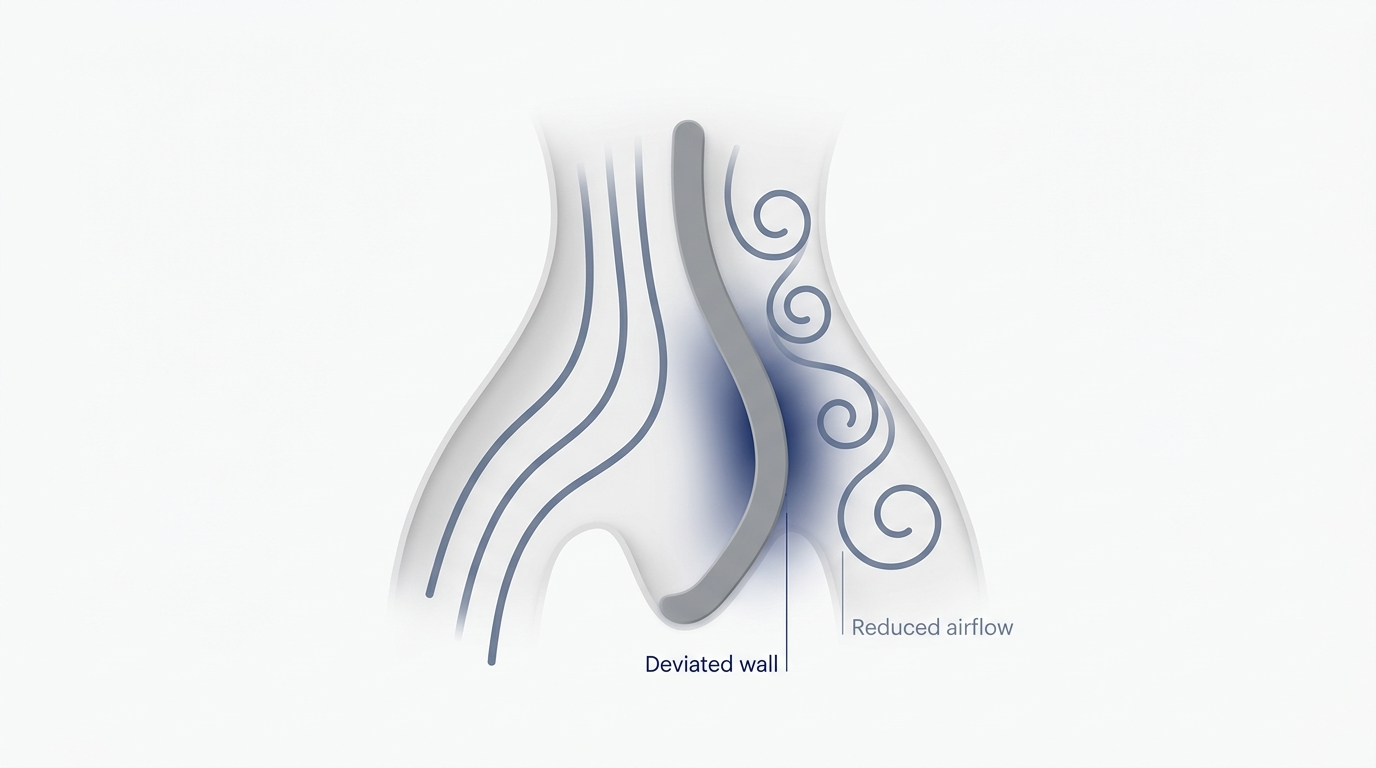
Why sprays and allergy meds don’t always fix it
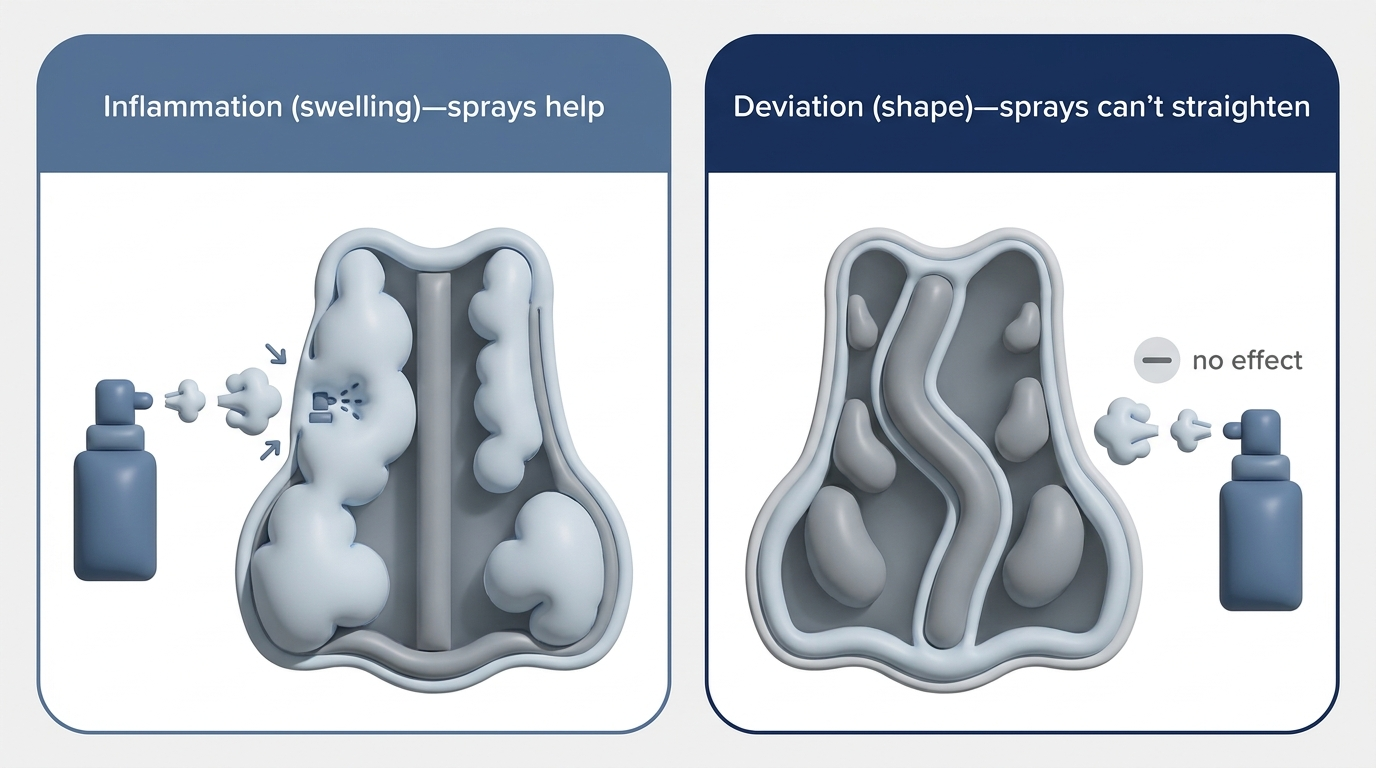
Nasal sprays and allergy medications can be very effective when swelling is the main issue (inflammation). But when the problem is structural—like a septum that’s physically blocking airflow—medication often can’t move that structure out of the way.
A useful way to think about it: inflammation is tissue swelling, while a deviation is shape or position. Sprays can calm swollen tissue; they can’t reliably straighten a wall.
For more background, see the difference between rhinitis and structural blockage.
Bottom line: If everyday breathing feels harder than it should, a structural issue like a deviated septum could be part of the reason—and it may not respond fully to sprays alone.
Traditional Septoplasty vs. Mobilization With Guided Pressure (Often Without Cutting)
Many people assume all septum correction requires cutting. In reality, there are different approaches—ranging in invasiveness—based on what’s causing the blockage, where it sits in the nose, and whether other structures (like turbinates or the nasal valve) are also contributing.
What traditional septoplasty often involves
Traditional septoplasty commonly involves making incisions, lifting the lining tissue, and then reshaping or removing portions of cartilage and/or bone to improve the airway. That can be very effective, but it also involves more tissue disruption—which may lead to more swelling and post-procedure discomfort during recovery for some patients.
Some patients do very well with traditional surgery—especially when multiple structural issues need to be addressed at once. The key is matching the method to the anatomy and goals.
The key difference with ClearPath
The ClearPath Nasal Balloon System is designed to help mobilize and realign deviated septal structures using force-directed hydrostatic pressure, rather than cutting or removing tissue (1,2). In other words, the intent is deviated septum treatment through guided pressure that helps reposition the septum toward improved alignment, while aiming to preserve mucosal tissue when appropriate (1,2,3). Your ENT can explain whether that’s appropriate for your specific deviation.
In short: some approaches reshape by removing tissue; ClearPath is designed to help reposition septal structures with guided pressure—when anatomy and goals align.
How ClearPath Works: Controlled Hydrostatic Pressure (Simple Explanation)
Hydrostatic pressure in plain language
Hydrostatic pressure is steady pressure applied by fluid. With ClearPath, a small balloon is used to apply controlled pressure in a targeted area—more like guided reshaping through gentle force than cutting (1,2).
Why force direction matters
Not all pressure is the same. ClearPath uses force-directed pressure—meaning the device is designed to apply pressure in a specific direction to encourage the deviated area to move toward better alignment, rather than relying on brute force (2). This directional aspect is central to how balloon-assisted septal mobilization aims to create a more open pathway for airflow.
In practical terms, direction matters because septal deviations aren’t all the same. Some are more like a C-shape, others an S-shape, and the most obstructive point may be higher or lower in the nasal passage.
Tissue preservation: why less cutting can mean less disruption
When there’s less disruption to the nasal lining (mucosa), recovery may involve:
- Less bleeding
- Less swelling
- Less discomfort for some patients
Every nose is different, and your experience depends on your anatomy and the treatment plan your ENT recommends. ClearPath describes this approach as tissue-preserving and designed to reduce disruption compared with more invasive methods (2,3).
The goal is targeted, directionally controlled pressure that helps realign the septum while preserving tissue—so recovery may feel more manageable for some patients.
Step-by-Step: What Happens During a ClearPath Balloon Septum Procedure
This is a high-level overview of what a balloon-assisted septal mobilization procedure using ClearPath may look like. Your ENT will tailor the plan to your specific anatomy. For a more detailed, patient-friendly walkthrough, see the minute-by-minute walkthrough of the ClearPath procedure.
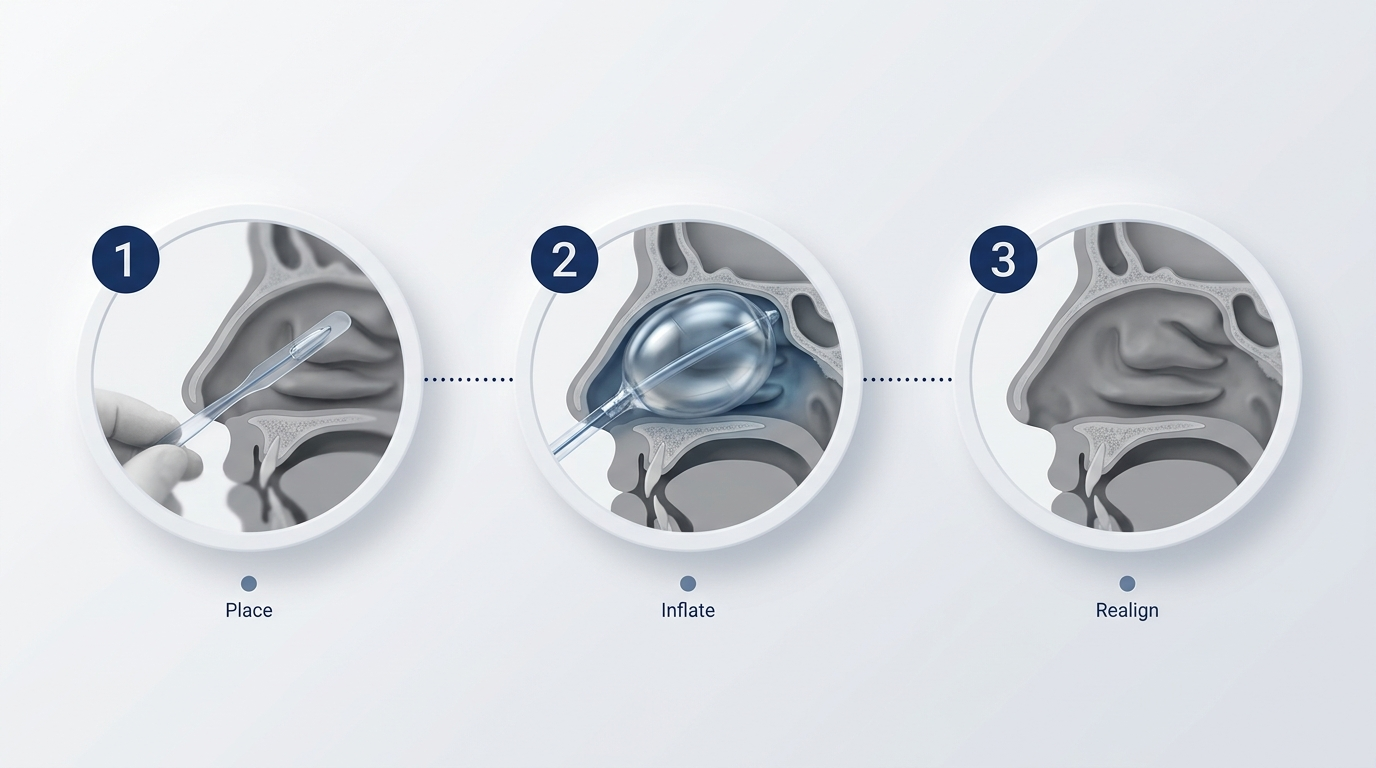
Step 1 — Positioning the catheter (guided placement)
The balloon catheter is positioned with guidance, including a spatula guide that supports precise placement (2). The goal is to place the balloon where the deviation is contributing most to airflow restriction.
Think of this step as measure twice, place once. Placement is important because the goal isn’t to inflate everywhere—it’s to apply controlled pressure where it can actually help.
Step 2 — Inflation: applying controlled pressure
Next, the balloon is inflated to apply controlled hydrostatic pressure at the targeted area (2). The inflation is intended to be steady and controlled—focused on mobilizing the deviated structures rather than cutting them.
Some patients worry that pressure automatically means pain. In reality, pressure sensations can be uncomfortable but brief—and the goal is to keep the experience manageable. Your ENT can explain what they typically do to support comfort during the procedure.
Step 3 — Mobilization and realignment
With the pressure applied, the deviated structures can be gently mobilized and shifted toward improved alignment—supporting septal realignment without tissue removal (1,2). The goal is a more symmetric nasal passage and a clearer airflow pathway, while aiming to preserve tissue (2,3).
Think: precise placement, controlled pressure, careful mobilization—tailored to your anatomy.
What Recovery Can Feel Like (and Why Many Patients Ask About This Approach)
Less post-procedure discomfort and sooner return to normal activities
Because ClearPath is designed to minimize cutting and preserve tissue, it may be associated with a more comfortable recovery than more invasive approaches for some patients. ClearPath materials describe reduced disruption as a reason many patients can return to normal routines sooner (2,3,5).
A common patient goal is simple: I want to improve airflow without a long downtime. Timelines vary, and your ENT can set expectations for your specific case.
Nasal packing may not be needed in many cases
One commonly discussed benefit is that nasal packing may not be needed in many cases—something many patients feel anxious about. ClearPath FAQs and procedural materials note that packing is often avoided with this approach (2,3). Ask your ENT directly: In my specific case, are packing or splints expected?
What you may still experience (setting realistic expectations)
Even with a minimally invasive approach, it’s normal to have some temporary symptoms, such as:
- Congestion or stuffiness (swelling during early healing)
- Mild bleeding or drainage
- Tenderness or pressure in the nose
- A gradual improvement in airflow rather than an immediate overnight change
Many patients notice that breathing improves in steps—especially as swelling settles and the nose feels less reactive. For simple early-recovery guidance, see the first 48-hour checklist after ClearPath treatment.
Call your doctor if you have heavy bleeding that won’t stop, worsening severe pain, fever, or any symptom that feels urgent or unusual for you.
The aim is a smoother, shorter recovery for many patients—while recognizing that healing still takes time and varies by person.
What the Evidence Shows So Far (Patient-Friendly Summary of Outcomes)
It’s reasonable to ask: Does this actually work, and how do we know? Early outcomes for force-directed, balloon-assisted septal mobilization have been reported in a retrospective analysis (4).
Study size and what was measured
In a 2026 paper, outcomes were reported for 107 consecutive cases. Among these patients:
- 23 had pre- and post-procedure CT scans (objective alignment measurement)
- 43 completed SNOT-22 symptom surveys (patient-reported outcomes) (4)
SNOT-22 is a widely used symptom questionnaire in sinus and nasal care; it’s one way researchers capture how patients feel and function after treatment.
CT scans showed improvement in septal symmetry
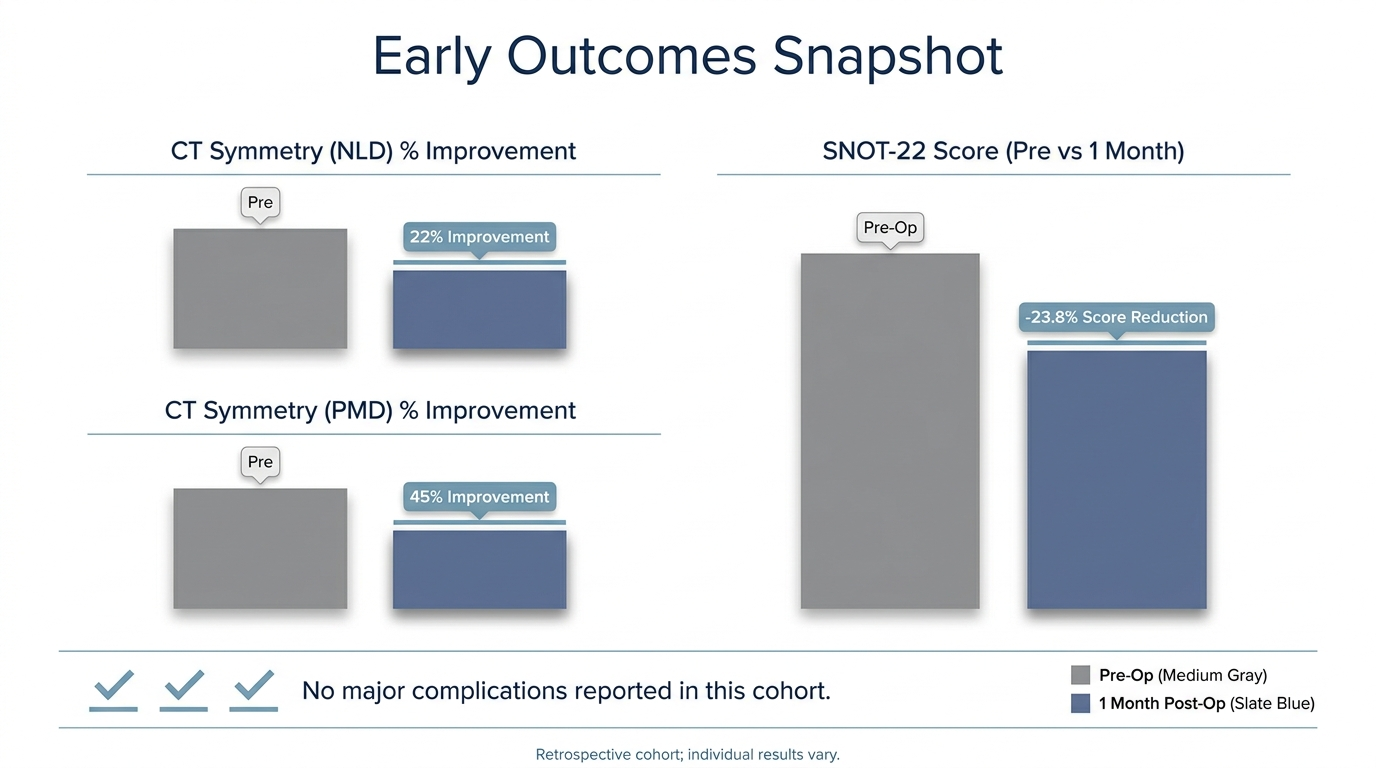
On CT imaging, mean septal symmetry improved by:
- 22% at the nasolacrimal duct (NLD) level
- 45% at the point of maximal deviation (PMD) (4)
In plain terms: imaging suggested the septum appeared more centered after the procedure, particularly at the most deviated point.
Patients reported symptom improvement at 1 month
In the group completing symptom surveys, SNOT-22 scores improved from 58.7 to 44.8 at one month—a 23.8% reduction (an average drop of 13.9 points). Reported areas with the largest improvements included nasal congestion, headache/facial pressure, and sleep quality (4).
Safety signals in the cohort
In this published cohort, no major complications were reported, including septal perforation, hematoma, mucosal injury, infection, synechia, or conversion to traditional septoplasty (4). This does not eliminate risk; it simply reflects what was observed in this specific analysis.
Severe deviations may see larger proportional correction
When outcomes were grouped by severity, the most severe deviations (>10 mm) showed the largest proportional correction. In the CT subgroup, 78% (18/23) achieved at least 30% alignment improvement (4).
Important note: This is promising early, real-world data, but it’s still retrospective with smaller subgroups for CT and surveys. Individual outcomes vary based on anatomy, goals, and any other contributing nasal conditions.
Early data suggest improved alignment and symptoms in many patients, with no major complications reported in that cohort—though larger, prospective studies would add clarity.
Who Might Be a Good Candidate (and Who Might Not)
Signs ClearPath may be worth asking about
You may want to ask an ENT about the ClearPath Nasal Balloon System if you have:
- Persistent, mostly one-sided obstruction
- A sense that airflow is blocked by structure, not just swelling
- Symptoms that affect sleep, exercise, or day-to-day comfort
For a deeper dive, see best candidates for balloon septoplasty with ClearPath.
Reasons an ENT might recommend a different approach
ClearPath may not be the best fit for everyone. An ENT might recommend a different plan if you have:
- More complex deformities or multiple structural issues that need broader correction
- History of prior nasal surgery that changes anatomy
- Other nasal conditions that need additional procedures addressed at the same time
A consultation and nasal exam are the best way to decide what’s appropriate.
The right approach depends on your anatomy and goals—your ENT can help you weigh options.
Questions to Ask Your ENT at a Consultation
Diagnosis and planning
- Is my blockage mostly structural (septum) or inflammation (rhinitis/allergies)?
- Do I also have turbinate enlargement or nasal valve collapse?
Procedure and recovery
- Will I need packing or splints?
- What’s the realistic recovery timeline for my case?
Outcomes
- How will we measure improvement—symptoms, airflow testing, imaging?
Key Takeaways: Realignment Without Cutting Is the Goal
- ClearPath uses force-directed hydrostatic pressure to help mobilize and realign the septum, rather than cutting or removing tissue (1,2).
- This minimally invasive approach is intended to reduce tissue disruption and may support a smoother recovery for some patients—packing may not be needed in many cases (2,3).
- Early reported outcomes show improvements in alignment and symptom scores in a retrospective cohort, with no major complications reported in that group (4).
If you’re exploring options for nasal obstruction, ask your local ENT whether you may be a candidate for balloon-assisted septal mobilization with the ClearPath Nasal Balloon System—and which option (ClearPath vs. traditional septoplasty) best matches your anatomy and goals.
FAQ
Does ClearPath hurt?
You should expect some pressure and tenderness, but discomfort varies by person. Because the approach is designed to avoid cutting and preserve tissue when appropriate, many patients anticipate a manageable recovery experience compared with more invasive approaches (2,3).
Is it surgery?
It is a medical procedure intended to address structural nasal blockage. It’s often described as minimally invasive because it focuses on mobilization and realignment rather than tissue removal (1,2).
How fast can I return to work?
Return-to-work timing depends on your job and your individual recovery. Many patients plan for a short recovery window, but your ENT should give guidance based on your anatomy and treatment plan.
Will I need packing?
Nasal packing may not be needed in many cases. ClearPath materials note that packing is often avoided with this approach, but your ENT will decide what’s appropriate for you (2,3).
References
1. ClearPath Nasal. For Physicians. https://www.clearpathnasal.com/for-physicians
2. ClearPath Nasal. ClearPath Playbook (PDF). https://cdn.prod.website-files.com/677c332b780dde6482217dbf/67d2f0e3114831f3dd6189e1_ClearPath%2BPlaybook-compressed.pdf
3. ClearPath Nasal. FAQs. https://www.clearpathnasal.com/faqs
4. Dillard J, Koudouovoh C, Lee V, et al. Outcomes of force-directed balloon-assisted endoscopic septoplasty: a retrospective analysis with a new technique and device. Rhinology Online. 2026;9:18–23. doi:10.4193/RHINOL/25.018
5. Sleep & Sinus Centers. Balloon septoplasty with ClearPath: a less invasive fix for a deviated septum. https://sleepandsinuscenters.com/blog/balloon-septoplasty-with-clearpath-a-less-invasive-fix-for-a-deviated-septum
This article is for educational purposes only and is not medical advice. Please consult a qualified healthcare provider for diagnosis and treatment.

Dr. David G. Dillard
Author
Share it with others!


